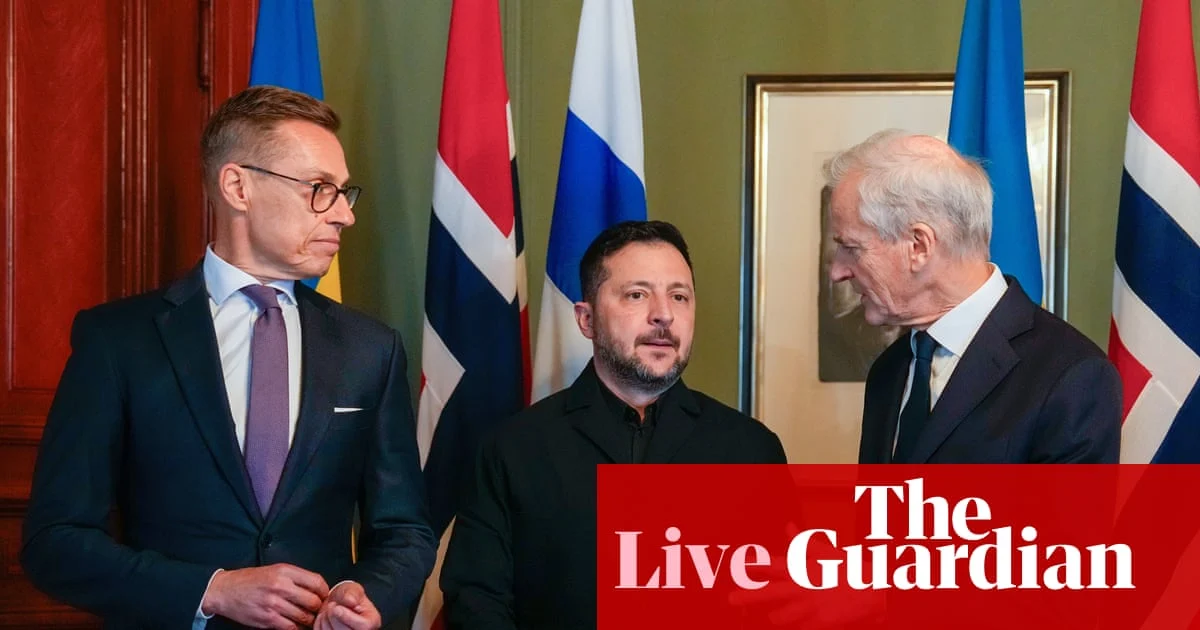
Russia launched 280 drones and 16 ballistic missiles at Ukraine overnight, Ukrainian President Volodymyr Zelenskyy said, even as a local ceasefire took effect in the Russian-occupied town of Oleshky. The coordinated attack underscores the fragility of localized truce efforts amid broader hostilities.
Despite the declared pause in fighting in Oleshky, missile and drone activity continued across other parts of Ukraine, suggesting that regional de-escalation remains limited in scope. Zelenskyy’s statement came hours after reports of diplomatic engagement involving Nordic leaders, raising questions about whether current negotiations can extend beyond isolated areas.
KEY FACTS
- Russia launched 280 drones at Ukraine overnight, per Zelenskyy.
- Sixteen ballistic missiles were also fired despite a local ceasefire in Oleshky.
- A local ceasefire began in Oleshky, a Russian-occupied town, marking a rare pause in intense combat.
- Ukrainian President Volodymyr Zelenskyy reported the details of the overnight assault.
- Nordic leaders may have been involved in renewed diplomatic efforts following earlier U.S.-Ukrainian talks in Oslo.
What Happened Overnight?
The overnight assault reportedly involved a large-scale barrage of drones targeting multiple sites across Ukraine, alongside 16 ballistic missiles. These figures were disclosed directly by President Zelenskyy, who has repeatedly provided updates on Russian offensive operations. While the scale of the attack highlights ongoing military pressure, it also contradicts the notion of a nationwide ceasefire, as the truce appears confined only to Oleshky.
Local truces in conflict zones often serve as confidence-building measures, but they can be undermined by continued hostilities elsewhere. In this case, the contrast between a fragile local pause and sustained national-level attacks raises concerns about whether partial de-escalation can hold without broader agreements. The Ukrainian leadership has not disclosed damage or casualties from the latest wave of strikes.
Who Is Affected and How Did We Get Here?
The people of Oleshky — located in the Russian-occupied part of Kherson Oblast — are directly affected by the local ceasefire. For them, the truce represents a temporary reprieve from daily bombardment and skirmishes. However, residents in other parts of Ukraine remain exposed to missile and drone fire, indicating that humanitarian relief and safety are not uniformly distributed across the country.
Talks involving the United States, Ukraine, Norway, and Finland earlier this month may have contributed to the conditions leading to the Oleshky ceasefire. Norway’s Prime Minister Jonas Gahr Støre and Finland’s President Alexander Stubb hosted those discussions in Oslo, signaling continued Western involvement in diplomatic attempts. Whether these channels will lead to further localized agreements remains uncertain.
What Happens Next?
Public statements from Kyiv suggest that diplomatic momentum may hinge on whether additional local truces can be negotiated or sustained. The international community is watching to see if the Nordic-mediated dialogue will yield expanded pauses in hostilities. At present, the situation remains volatile, with no indication of a nationwide truce.
WHAT WE KNOW — AND WHAT WE DON’T
Verified by the source:
- Russia launched 280 drones at Ukraine overnight.
- Sixteen ballistic missiles were also launched during the same period.
- A local ceasefire began in the Russian-occupied town of Oleshky.
- Ukrainian President Volodymyr Zelenskyy disclosed these facts.
- Nordic leaders possibly engaged in renewed talks after hosting prior U.S.-Ukrainian meetings.
Still unconfirmed:
- Exact time and location of the drone and missile launches.
- Casualties or infrastructure damage resulting from the attacks.
- Formal confirmation of active diplomatic involvement by Nordic leaders today.
- Terms or duration of the Oleshky local ceasefire.
- Whether the strikes targeted military or civilian areas.
Why It Matters
This development reflects the uneven nature of de-escalation in active war zones, where limited truces offer temporary relief but fail to guarantee lasting stability. For global audiences, it signals that even diplomatic breakthroughs may not stem the tide of large-scale military operations without coordinated, nationwide accords. Continued Western engagement, especially through neutral mediators like Norway and Finland, could shape future negotiations — though outcomes remain highly unpredictable. Follow our war-geopolitics coverage for ongoing updates on evolving tensions in the region. Explore related political developments here.
What To Watch
Further statements from Ukrainian and Russian officials are expected, as are reactions from international partners involved in ongoing diplomatic efforts. The durability of the Oleshky ceasefire will be tested in the coming days.