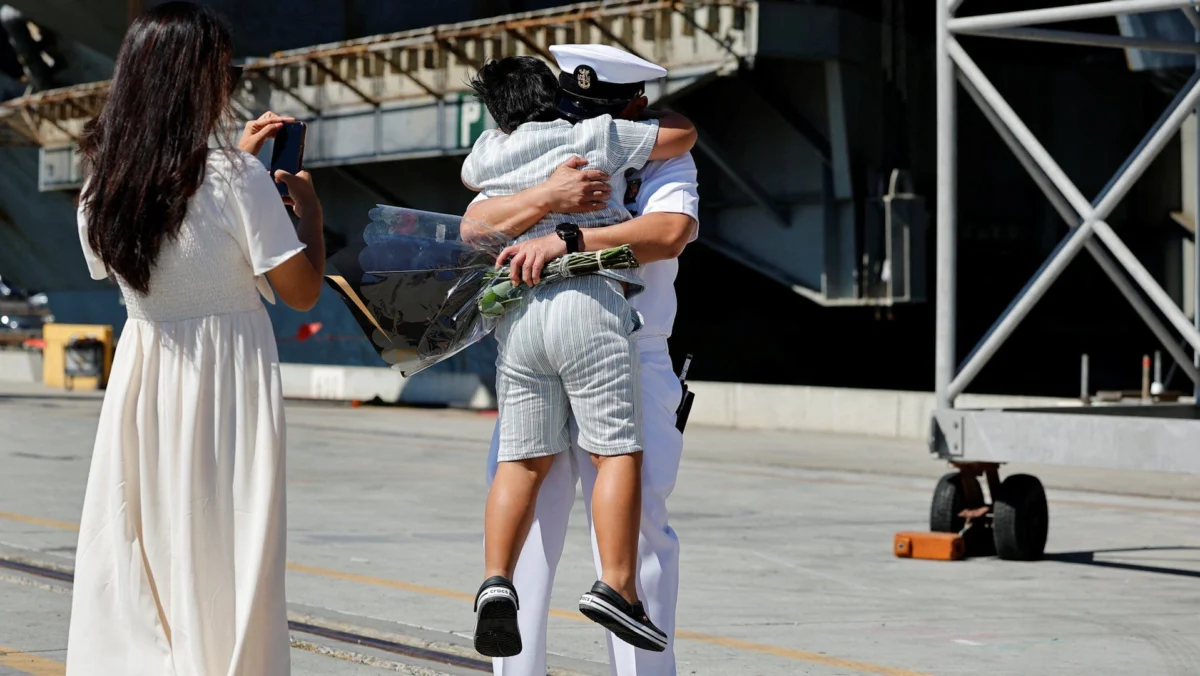
The USS Abraham Lincoln has returned to San Diego after more than 300 days at sea, marking a record-breaking deployment. Families embraced their loved ones upon the carrier’s homecoming, capping one of the longest continuous deployments in recent Naval history. The return brings closure to sailors and their families who spent over ten months apart.
The deployment stretched beyond typical carrier rotations, reflecting sustained global engagement amid shifting strategic priorities. Crew members remained operationally active throughout, supporting missions that required persistent presence far from home ports.
Key Facts
- The USS Abraham Lincoln returned to San Diego after more than 300 days at sea.
- The deployment was described as record-breaking.
- Families embraced their loved ones upon the ship’s return.
What Happened During the Deployment
Deployments of this length are rare for U.S. Navy carriers, which typically rotate every six to nine months. A 300-day deployment means the crew lived and worked aboard ship for significantly longer than usual, with limited shore leave and rotated personnel supplementing the core crew to maintain readiness. While the summary does not specify mission details, extended deployments often align with heightened geopolitical activity requiring sustained military presence. The ship’s return marks the end of an intense operational period and allows for rest, resupply, and crew rotation. It also provides a chance for sailors to reconnect with family and receive recognition for their service during a demanding assignment.
Who Is Affected by the Return
The primary individuals affected are the crew members of the USS Abraham Lincoln and their families. Extended separations place strain on personal relationships, financial planning, and daily life logistics for spouses and children. Reunions after such long deployments are emotionally significant events, often involving carefully coordinated leave schedules and support programs designed to ease the transition back to shore-based routines. Military families frequently rely on counseling services and community support networks during these periods. The return also impacts Naval operations at San Diego, where maintenance, resupply, and crew rotation activities intensify immediately following a major deployment. Local businesses and volunteer organizations often participate in welcome-home efforts, though specific involvement was not detailed in the source reporting.
How Did This Deployment Become So Long
Navy deployment lengths are shaped by strategic demands, fleet availability, and global commitments. When operational needs exceed the number of available ships or rotate later than planned due to delays elsewhere, some vessels experience extensions. A 300-day deployment suggests the carrier group was retained well beyond its original schedule, possibly to fill gaps in theater coverage or respond to evolving security conditions. While the summary does not name specific conflicts or regions, extended carrier deployments historically occur during periods of increased tension or when other assets are engaged elsewhere. The Navy periodically reviews deployment cycles to balance readiness with personnel welfare, and unusually long missions may prompt policy adjustments in future rotations.
What We Know — and What We Don’t
Verified by the source:
- The USS Abraham Lincoln returned to San Diego.
- The deployment lasted more than 300 days.
- Families greeted their loved ones upon return.
- The deployment was characterized as record-breaking.
Still unconfirmed:
- The exact start date or duration in days.
- The specific missions or regions where the ship operated.
- The total number of crew members onboard.
- Whether the deployment was extended due to planned or unplanned circumstances.
- Any injuries, losses, or significant incidents during the deployment.
Why It Matters
Extended military deployments test the endurance of both service members and their families, highlighting the human cost of sustained global engagement. They also reflect how naval forces adapt to complex international environments that demand long-term readiness.
What To Watch
Future reports may shed light on the operational outcomes of this deployment and any adjustments to future carrier rotation schedules. Officials have yet to release detailed mission summaries.
The USS Abraham Lincoln’s return after a record-breaking deployment underscores the sustained commitment of the U.S. Navy in global operations.