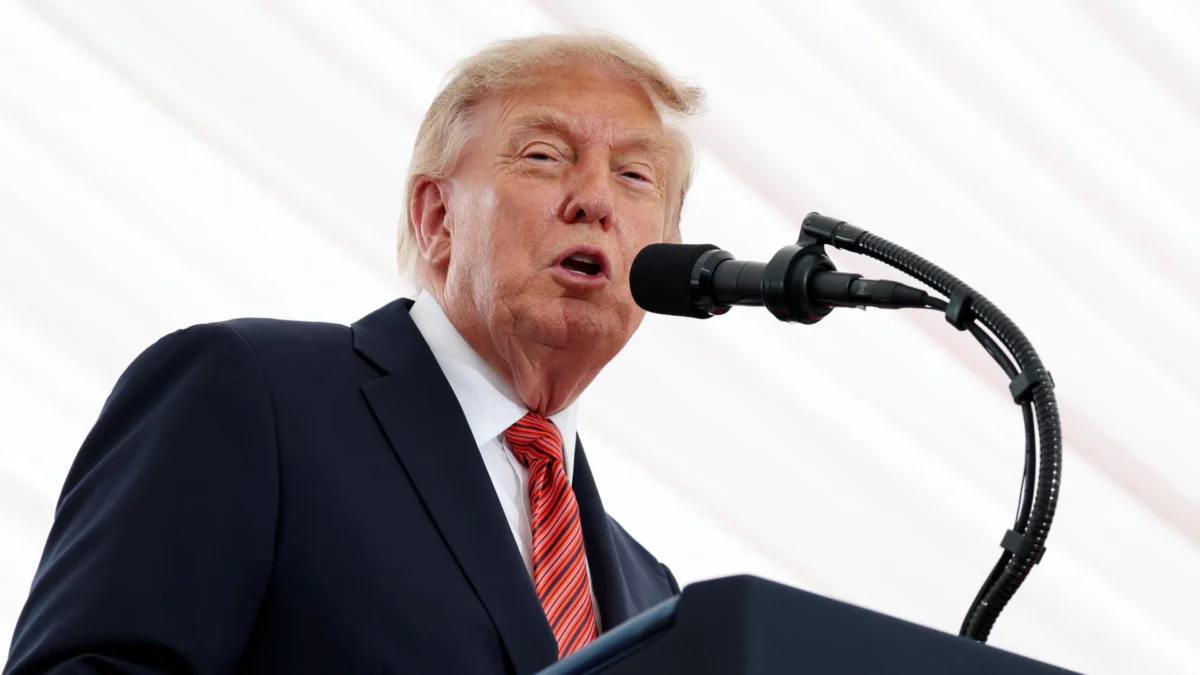
At the All-In Summit, President Trump phoned Nvidia CEO Jensen Huang and dismissed concerns about data center development as a hoax, according to US Top News and Analysis. The president has also used his social media platform to criticize Anthropic CEO Dario Amodei’s call for slowing AI development. These actions signal growing political scrutiny of the AI industry’s rapid expansion and energy demands.
The remarks highlight mounting friction between U.S. policymakers and tech leaders who are navigating both innovation and infrastructure challenges. As artificial intelligence reshapes the economy, questions about data center growth, power consumption, and development speed increasingly fall under public debate.
KEY FACTS
- President Trump phoned Nvidia CEO Jensen Huang at the All-In Summit.
- Trump described data center opposition as a “hoax.”
- He criticized Anthropic CEO Dario Amodei’s suggestion to slow AI development.
- Trump used his social media site to voice his views on AI regulation.
The Story
What happens next?
President Trump’s direct engagement with Nvidia and commentary on AI development pace underscores how central tech policy has become in national discourse. The White House has not issued formal guidance on data center expansion or AI timelines, but Trump’s public statements may influence future regulatory direction. Analysts watching economy and markets expect further clarity if the administration moves to formalize policies around AI infrastructure and growth.
For companies like Nvidia, which depend on government relationships and large-scale computing projects, these signals matter. A shift toward fewer restrictions could accelerate data center builds and chip demand, while slower development might delay investments. The outcome affects not only tech firms but also energy providers, investors, and supply chains tied to AI scaling.
Why AI development pace is under scrutiny
The debate over data center opposition centers on balancing innovation with environmental and energy costs. Critics argue that unchecked growth strains power grids and raises carbon footprints. Supporters say halting progress risks ceding global leadership to rivals. Trump’s framing of these concerns as a hoax aligns with a broader push to reduce regulatory barriers for technology firms. This stance contrasts with cautious voices inside and outside the industry calling for deliberate steps forward.
As AI models grow more complex, the infrastructure required to train and run them expands rapidly. Each major release demands new server farms, often located near cheap energy sources. Opposition to some proposed sites has emerged from local communities concerned about noise, heat, and land use. Whether these tensions escalate into formal policy battles remains uncertain, especially as elections approach and voter sentiment shifts.
Who is affected by Trump’s AI stance
Tech executives, clean energy groups, and regional planners are among those impacted by the shifting political climate around AI expansion. Nvidia and other semiconductor manufacturers rely heavily on steady demand from data center operators. Any perceived hostility from the administration toward slowing down could reassure investors bullish on AI growth. Conversely, public backlash over energy use may pressure companies to adopt greener practices regardless of federal posture.</p
WHAT WE KNOW — AND WHAT WE DON’
Verified by the source:
- Trump made a phone call to Jensen Huang at the All-In Summit.
- He referred to data center opposition as a hoax.
- He criticized Dario Amodei’s suggestion to slow AI development.
- He posted his views via his social media platform.
Still unconfirmed:
- The exact date and time of the phone call.
- Detailed content of Trump’s comments beyond what was reported.
- Official responses from Nvidia or the White House.
- Policy implications or next steps from the administration.
WHY IT MATTERS
Political backing for swift AI advancement can shape investment flows, energy planning, and global competitiveness. Decisions made now about data center growth and development speed will ripple across sectors including electricity generation, real estate, and international trade. For citizens, this could mean changes in electricity costs, job creation in tech hubs, and evolving privacy norms tied to AI adoption.
WHAT TO WATCH
Watch for official statements from the White House or Commerce Department outlining a clear policy direction for AI infrastructure. Additional public remarks from President Trump or tech leaders may clarify whether current momentum supports accelerated or restrained expansion of data centers nationwide. For continued updates, follow our tech and AI coverage.