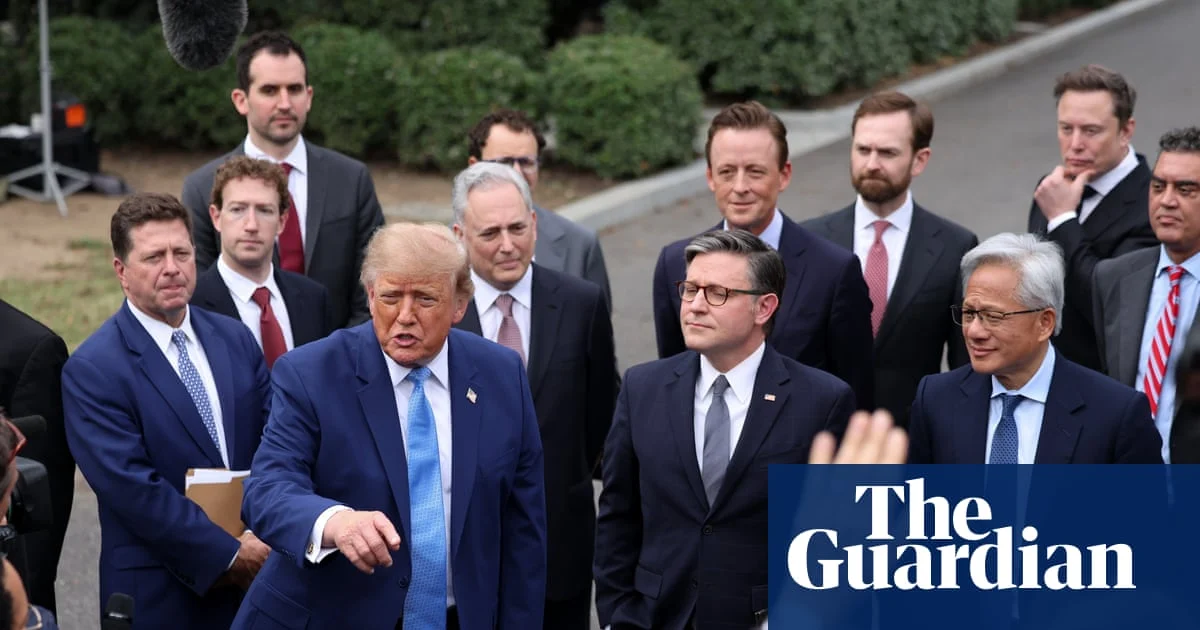
LEDE
US President Donald Trump announced that executives from major technology firms signed a voluntary artificial intelligence agreement referred to as a ‘morally binding’ commitment. The announcement followed a White House luncheon where Trump described the accord as a form of protection for the industry. He characterized the deal as resembling a constitution, suggesting it would enable ‘tremendous self-policing’ among participating companies.
The agreement, named the Joint Commitment On Frontier Responsibilities, was presented without specific details about enforcement mechanisms or participating organizations. Trump’s comments came amid ongoing global discussions about regulating advanced artificial intelligence systems and their potential risks to society.
KEY FACTS
- Trump announced the deal after a White House luncheon with tech CEOs.
- The agreement is called the Joint Commitment On Frontier Responsibilities.
- Trump described the deal as ‘morally binding’ and enabling ‘tremendous self-policing’.
- He compared the agreement to a constitution in significance.
- An executive order officially rebranded ‘artificial intelligence’ as ‘superintelligence’.
THE STORY
What happens next?
The lack of concrete details raises questions about implementation and accountability. Without named companies, legal oversight bodies, or enforcement structures, observers may find the announcement more symbolic than actionable. However, if major firms do adhere internally to shared standards, even voluntary commitments can influence industry practices around safety and transparency.
This development aligns with broader international momentum toward AI governance frameworks. Countries across Europe and Asia have introduced or proposed laws governing machine learning applications, data usage, and algorithmic decision-making processes. In contrast, the United States has taken a more decentralized approach, favoring private-sector leadership over federal mandates.
Trump emphasized presidential involvement by stating he himself signed the document during the event. Whether future administrations maintain support for such initiatives will likely depend on evolving perceptions of technological risk versus innovation incentives.
What do we know and not know?
Verified by the source:
- President Trump hosted a White House meeting with tech industry leaders.
- A document titled Joint Commitment On Frontier Responsibilities was signed.
- Trump called the agreement morally binding and likened it to a constitution.
- An executive order changed terminology from artificial intelligence to superintelligence.
Still unconfirmed:
- List of specific companies or executives involved.
- Text or contents of the signed commitment.
- Mechanisms for monitoring compliance or resolving disputes.
- Timeline for follow-up actions or evaluations.
WHY IT MATTERS
As generative AI tools become integrated into daily life, public trust depends partly on transparent governance structures. Voluntary pacts like this one attempt to preempt stricter regulation while signaling corporate responsibility to lawmakers and consumers worldwide.
WHAT TO WATCH
Further clarification from the White House or participating firms could determine whether this becomes a meaningful framework or remains largely rhetorical.