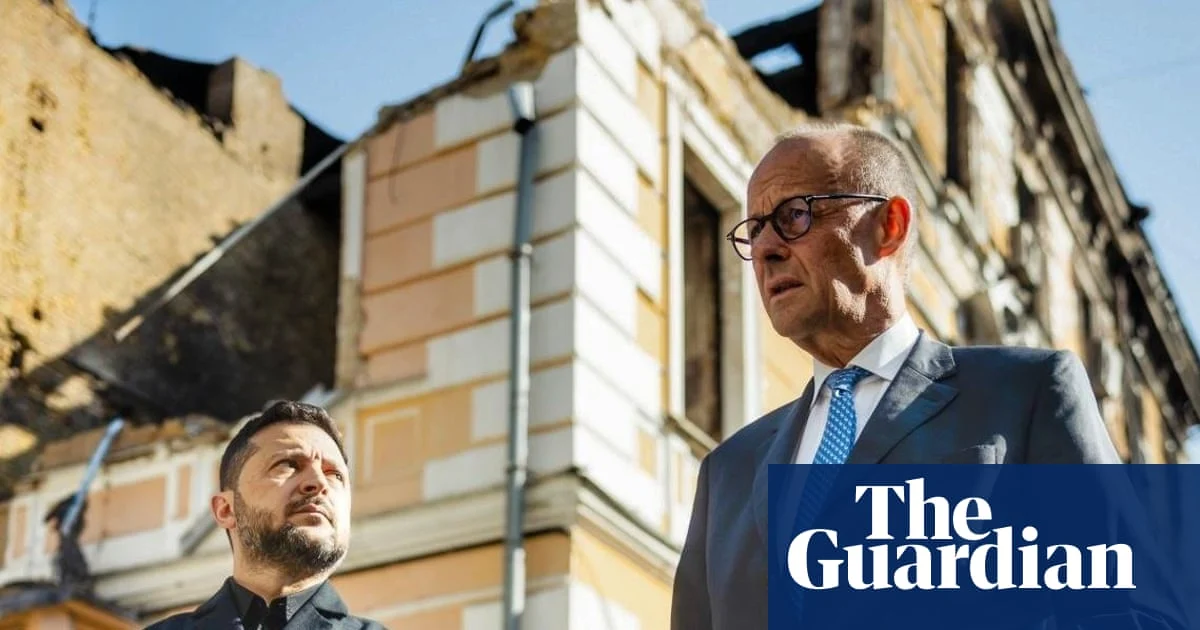
German Chancellor Friedrich Merz pledged €1bn in military aid to Ukraine during a visit to Kyiv on Sunday, vowing continued support despite intensified Russian attacks on Ukrainian cities and infrastructure. Speaking alongside President Volodymyr Zelenskyy, Merz said Germany would also fund joint production of drones to intercept Russian jet-powered drones, citing recent technical progress that is accelerating output. The announcement came amid repeated air raid sirens and explosions across Kyiv during his visit, including a drone strike on the Northern Bridge over the Dnipro River.
Key Facts
- Merz announced €1bn ($1.1bn) in military aid during a visit to Kyiv.
- Germany will fund joint production of drones to intercept Russian jet-powered drones.
- Merz also announced €350m for repairs to Ukraine’s energy sector.
- German officials said 14 agreements worth about €6.6bn were signed with Ukrainian partners.
- A Russian drone struck Kyiv’s Northern Bridge, the fourth straight day of bridge attacks.
What Is Included in Germany’s Support?
The military aid package forms part of broader agreements signed during the visit. German officials said company executives travelling with Merz finalised 14 deals collectively valued at roughly €6.6bn. Among them were agreements with Diehl Defence for IRIS-T air defence missiles, Hensoldt for radar equipment, and Quantum Systems for jet drone interceptors. These contracts reflect Berlin’s effort to scale up defence collaboration with Kyiv, combining public funding with private-sector capacity. The drone interceptor initiative highlights a particular focus on countering Russian aerial threats, which have targeted energy infrastructure and transport hubs ahead of winter.
What Happens Next?
Russia continued its campaign of infrastructure strikes during Merz’s visit. Video footage reportedly showed cars driving across Kyiv’s Northern Bridge moments before a drone struck the roadway in a burst of fire. A separate airstrike hit Kharkiv, Ukraine’s second-largest city, killing one person and injuring six, according to the city’s mayor. The repeated targeting of bridges used by commuters underscores how civilian infrastructure remains in the crosshairs. Ukrainian officials have accused North Korea of sharing jet-drone technology with Russia, though no independent confirmation was provided.
Russia’s Hybrid Tactics and International Responses
Merz framed Germany’s support as tied to European security, warning that Russia’s cyber-attacks and disinformation campaigns threaten democratic institutions. Moscow has dismissed such accusations as baseless and driven by anti-Russian sentiment. Meanwhile, Ukraine’s foreign ministry said drones were used to deliver nearly four metric tons of food and medicine to the occupied southern town of Oleshky, describing conditions there as “a hell on earth.” Efforts to broker peace gained attention as the United States signalled interest in renewed talks by late October, while India said it is expanding its mediation role.
What We Know — and What We Don’t
Verified by the source:
- Germany pledged €1bn in military aid and €350m for energy repairs.
- Fourteen agreements worth €6.6bn were signed with German companies.
- A Russian drone hit Kyiv’s Northern Bridge during Merz’s visit.
- Airstrikes on Kharkiv left at least one dead and six injured.
- Ukraine delivered humanitarian supplies to Oleshky using drones.
Still unconfirmed:
- Whether North Korea has received advanced Russian drone technology.
- The exact scope and timeline of future peace negotiations.
- Full details of India’s engagement with both warring parties.
- Independent verification of Moscow’s cyber and disinformation claims.
Why It Matters
Germany’s increased aid signals sustained Western backing for Ukraine as winter approaches and Russian strikes on critical infrastructure escalate. How allies balance material support, diplomatic outreach, and deterrence will shape both the trajectory of the conflict and broader European security.
What To Watch
All eyes are on whether upcoming peace initiatives materialise and how Russia responds to stepped-up Western defence cooperation.