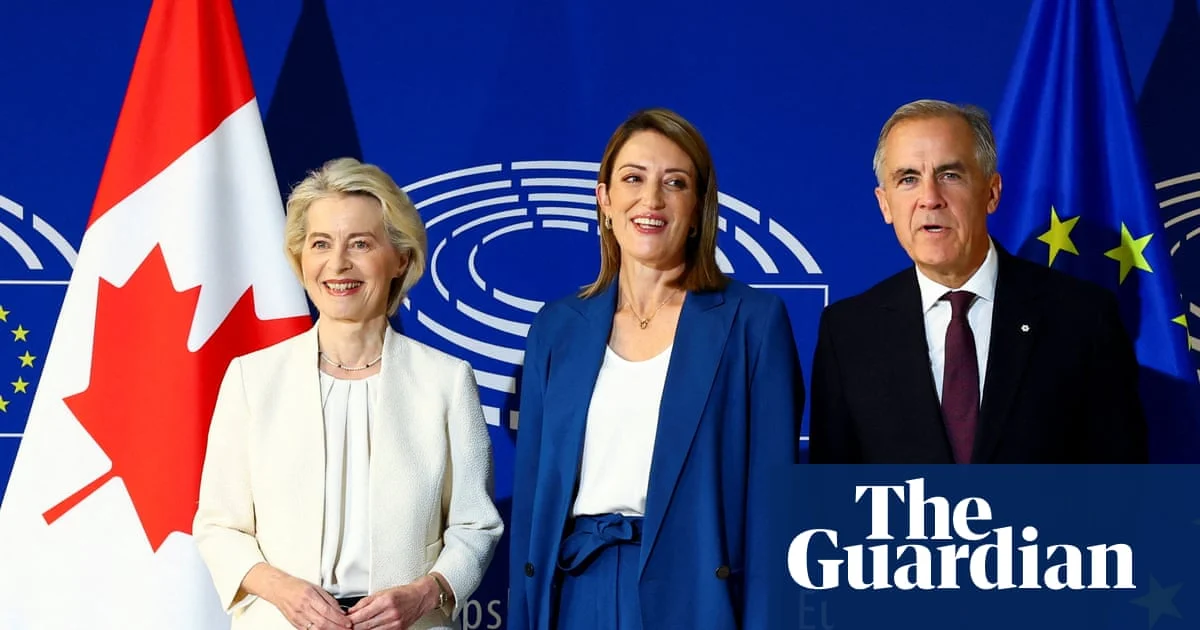
Brussels — The European Commission has invited Canada to become the first-ever associate member of the European Union, marking a potentially historic shift in the bloc’s approach to international partnerships. The offer was announced by European Commission President Ursula von der Leyen, who emphasized that Canada and the EU “see the world with the same eyes” through shared democratic values and aligned positions on global challenges. This unprecedented move signals a new chapter in transatlantic and continental cooperation, though the specifics of what associate membership entails remain undefined at this stage.
In an unusual public declaration, von der Leyen framed the proposal as more than symbolic diplomacy. She described it as a pathway to “common prosperity,” rooted in long-standing alignment on issues ranging from artificial intelligence governance to climate action, support for Ukraine, and broader geopolitical strategy. While full EU membership has historically required meeting strict economic, legal, and institutional criteria under the Copenhagen criteria, associate membership would represent a new tier of formal partnership without full voting rights or unconditional access to all EU policies.
Key Facts
- EU invites Canada to become its first-ever associate member, per a statement by European Commission President Ursula von der Leyen.
- The proposal emphasizes shared democratic values and common approaches to AI, climate breakdown, the Ukraine war, and geopolitics.
- Von der Leyen said the EU and Canada “see the world with the same eyes.”
- The goal of the partnership is to foster common prosperity, according to the Commission chief.
- The announcement was made on Wednesday in an unprecedented offer not previously reported.
What Happens Next?
The invitation raises immediate questions about procedural next steps, institutional response timelines, and how such a novel arrangement might function within existing treaties. Associate membership has never before been granted by the EU, meaning there are no formal precedents for ratification processes, legal frameworks, or parliamentary approvals required from either side. No timeline for negotiations or implementation has been disclosed in initial reporting.
Canada’s federal government has not yet issued a public response beyond acknowledging receipt of the invitation. Ottawa would likely need to conduct its own domestic consultations involving Indigenous communities, provincial leaders, and trade stakeholders before entering formal talks. Analysts suggest that even exploratory discussions could take months, depending on political appetite in both Brussels and Ottawa.
Meanwhile, reactions among EU member states remain undisclosed publicly. Some nations may welcome deeper ties with a NATO ally and G7 partner, while others may express concern over dilution of decision-making authority or precedent-setting risks. Formal debate, if initiated, would fall under the purview of the European Council andEuropean Parliament, both of which hold veto-like influence over major structural changes.
Background and Context
The concept of associate membership reflects growing interest within the EU to deepen strategic relationships beyond traditional bilateral agreements. Past instances—such as association agreements with countries like Ukraine, Georgia, and Moldova—have stopped short of institutional integration. A full associate membership model would sit somewhere between observer status and candidate country designation, offering selective access to markets, research programs, and security coordination mechanisms.
For Canada, enhanced partnership with the EU aligns with efforts to diversify export markets amid evolving U.S. trade dynamics. TheComprehensive Economic and Trade Agreement (CETA), provisionally applied since 2017, already facilitates significant commercial exchange. Expanding into broader cooperation areas—including digital governance, clean technology, and defense procurement—could strengthen mutual resilience against external shocks.
Verified by the Source: What We Know
- The European Commission president invited Canada to become the first-ever associate member of the EU.
- Ursula von der Leyen delivered the announcement and cited shared democratic values and aligned stances on key issues.
- The stated objective includes fostering common prosperity between the two partners.
Still Unconfirmed:
- Details regarding the scope, privileges, or obligations under a possible associate membership framework.
- Whether Canada formally accepts the invitation or initiates internal consultations.
- How existing EU member states or institutions will react politically or legally.
- If negotiations or timelines for implementation are underway.
Why It Matters
This unprecedented outreach underscores a recalibration in transatlantic strategy, especially as democratic alliances seek alternatives to unpredictable partnerships elsewhere. Should realized, associate membership could redefine how mid-sized democracies engage with regional blocs, setting potential precedents for future collaborations involving Japan, Australia, or Latin American nations.
What To Watch
All eyes now turn to Ottawa’s official stance and whether Brussels moves toward drafting concrete proposals for negotiation. Watch related developments in [politics] and [war-geopolitics].
The EU has invited Canada to become its first-ever associate member, a move announced by Commission President Ursula von der Leyen based on shared democratic values.