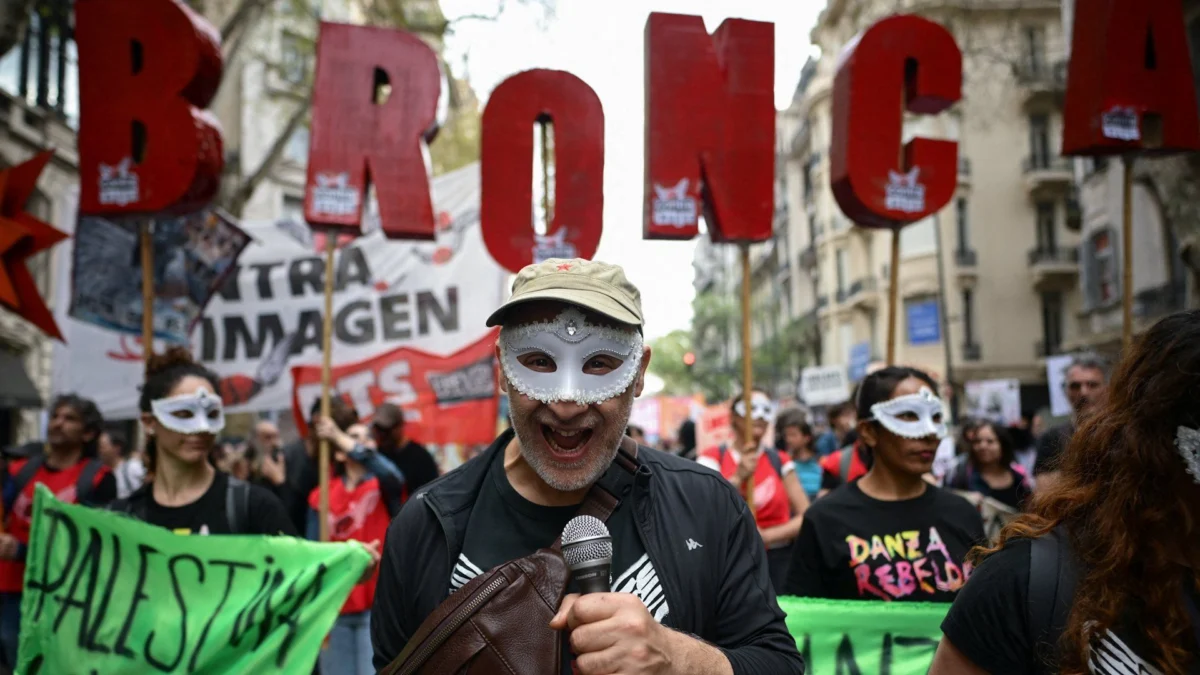
Thousands of protesters gathered in Buenos Aires for the ‘March of Anger,’ organized by Argentina’s left-wing opposition to voice opposition to President Javier Milei’s austerity policies. The demonstration, held in the capital city, brought together large numbers of citizens expressing dissent over recent economic reforms.
The ‘March of Anger’ represents one of the most significant displays of organized resistance to Milei’s agenda since he took office, reflecting deep divisions within Argentine society over the direction of national policy.
Key Facts
- Thousands of protesters took part in the ‘March of Anger’ in Buenos Aires.
- The protest targeted austerity measures implemented by President Javier Milei’s government.
- The demonstration was organized by Argentina’s left-wing political movement.
- The event occurred in the capital city of Buenos Aires.
- The protest was described as a public showing of anger over economic policies.
What sparked the March of Anger?
The ‘March of Anger’ was triggered by sweeping austerity measures enacted by President Javier Milei’s administration aimed at reducing public spending and restructuring the economy. These policies have led to widespread discontent among lower-income groups and opposition parties who argue that such steps disproportionately affect vulnerable populations. While supporters claim the reforms are necessary to stabilize the economy, critics see them as harmful cuts that deepen inequality.
Organizers of the ‘March of Anger’ framed the protest as a collective expression of frustration over rising costs of living and reduced access to social services. Demonstrators carried banners and chanted slogans denouncing what they described as regressive changes to labor rights and welfare programs. The scale of participation indicated broad concern across multiple sectors, though exact turnout figures remain unconfirmed.
Political analysts note that the ‘March of Anger’ highlights growing tension between Milei’s reformist vision and entrenched expectations around state support. His government continues to push forward with budget cuts despite domestic backlash, suggesting a prolonged period of political confrontation ahead.
Who is affected by Milei’s austerity?
The austerity measures promoted by President Milei impact various segments of Argentine society, particularly those reliant on government-funded programs. Cuts to education, healthcare, and transportation subsidies have raised concerns about accessibility and quality of public services. Labor unions estimate job losses in the public sector directly tied to downsizing efforts tied to these reforms.
Internationally, investors watch closely as market reactions to the ‘March of Anger’ could influence foreign confidence in Argentina’s economic trajectory. Meanwhile, ordinary citizens grapple with inflation fears intensified by subsidy reductions. As debates intensify ahead of potential legislative elections, both domestic policy outcomes and external alliances hang in balance—making clarity vital for understanding future developments surrounding this unfolding crisis.
What We Know — and What We Don’t
Verified by the source:
- A large-scale protest known as the ‘March of Anger’ took place in Buenos Aires.
- The event was organized by members of Argentina’s left-wing opposition.
- The purpose was to demonstrate opposition to President Milei’s austerity policies.
Still unconfirmed:
Why It Matters
This story matters because it reflects broader struggles across Latin America where populist leaders enact aggressive fiscal reforms amid economic instability. Citizens’ responses like the ‘March of Anger’ shape electoral landscapes and policy trajectories not only in Argentina but also in neighboring nations watching similar trends unfold.
What To Watch
Observers should monitor whether additional demonstrations follow the ‘March of Anger’ and how the Milei administration responds publicly moving forward.