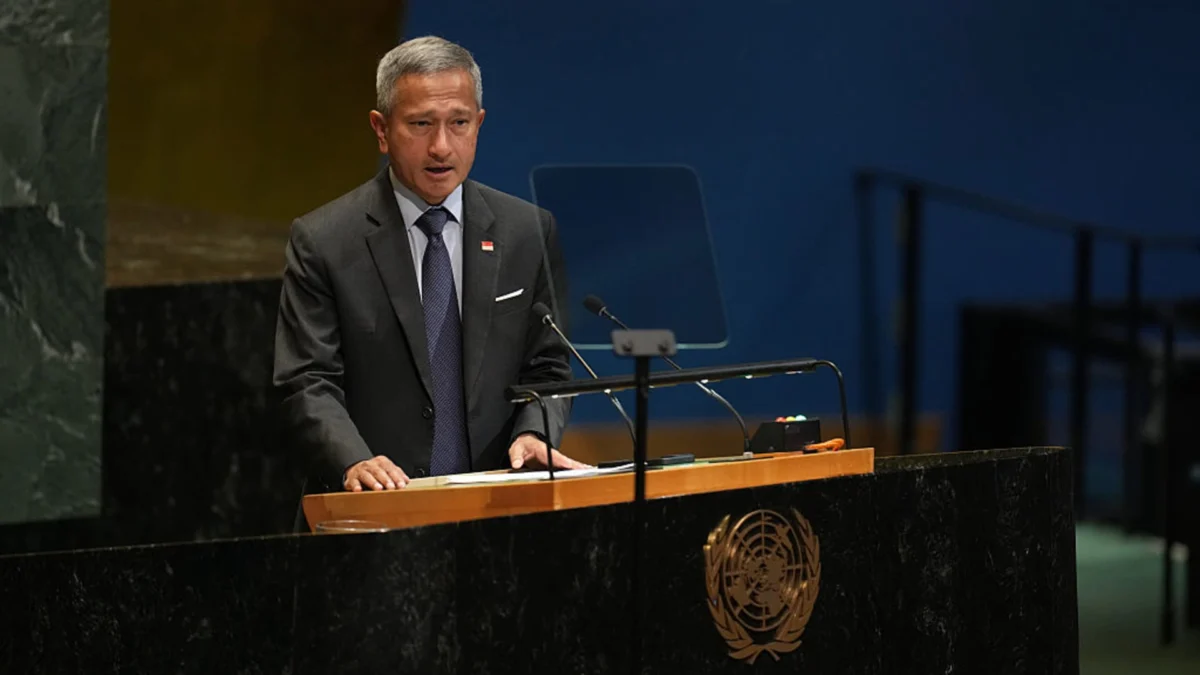
Singapore’s foreign minister has said that disruptions to shipping in the Hormuz waterway represent a problem for Asian economies, echoing — and partly validating — criticism from former U.S. President Donald Trump that regional nations should shoulder more of the security burden.
The Hormuz disruption has become a focal point of international concern after escalating tensions in the region. While Trump has argued that Asian economies, which depend heavily on energy shipments through the Strait of Hormuz, must take greater responsibility for keeping the route open, Singapore’s foreign minister suggested that Trump is not entirely wrong in his assessment.
Key Facts
- Trump says Asian economies should do more to protect Hormuz shipping.
- Singapore foreign minister says Hormuz disruption affects Asia directly.
- Singapore minister stops short of fully endorsing Trump’s stance.
- Hormuz carries a large share of global energy shipments.
- Tensions in the region have renewed focus on maritime security.
Why the Hormuz disruption matters now
The Hormuz disruption has gained renewed attention as geopolitical tensions raise concerns over the safety of one of the world’s most important oil transit routes. The strait, which connects the Persian Gulf to the Arabian Sea, handles roughly one-fifth of the world’s petroleum liquids by volume, including crude exports from Saudi Arabia, Iraq, and Iran.
For Asian economies such as China, Japan, and India, energy security is vital, and reliance on Gulf energy shipments has long shaped diplomatic and defense policy. Trump has repeatedly argued that these nations should contribute more to safeguarding the waterway, suggesting that the United States — and its taxpayers — should not indefinitely bear the cost alone.
What happens next?
The Hormuz disruption remains a flashpoint as regional actors weigh diplomatic, economic, and military options. Singapore’s measured response adds a notable diplomatic voice to the debate, indicating that some Asian governments acknowledge the need for shared responsibility while stopping short of endorsing U.S.-led security mechanisms.
How the Hormuz disruption evolves will depend on broader developments in regional diplomacy, energy markets, and naval activity. Analysts note that any major escalation could drive shipping costs higher and prompt further shifts in energy trade patterns, reinforcing the urgency of the security questions raised by Trump and now echoed by Singapore.
What We Know — and What We Don’t
Verified by the source:
- Trump has stated Asian economies should shoulder more of the burden protecting Hormuz shipping.
- Singapore’s foreign minister said the Hormuz disruption is Asia’s problem.
- The minister suggested Trump is not completely wrong on the issue.
- Hormuz is a key route for energy shipments relied upon by Asia.
Still unconfirmed:
- Details of Trump’s specific proposal to shift protection costs to Asia are not given.
- The full text or context of Singapore’s minister’s remarks is not provided.
- No other regional officials’ responses are cited in the source.
Why It Matters
The Hormuz disruption is not merely a regional concern — it is a linchpin of global energy markets. Because many economies depend on uninterrupted passage through the strait, questions of who pays to secure it reflect wider debates about international responsibility and burden-sharing, topics that resonate well beyond the economy and markets and war and geopolitics arenas.
What To Watch
Observers will watch whether other Asian foreign ministers follow Singapore’s lead in publicly addressing the Hormuz disruption and whether Trump’s calls for greater regional cost-sharing gain broader traction.