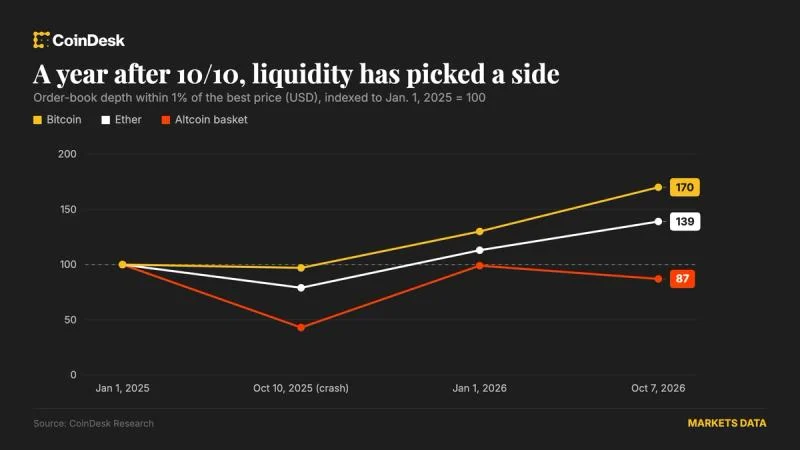
One year after the 10/10 flash crash, bitcoin and ether liquidity has largely recovered, yet altcoin liquidity remains vulnerable. While the two largest cryptocurrencies now show deeper order books than before the crash, altcoins continue to experience declining liquidity, and overall spot trading volume has yet to return to its October 2025 peak.
This uneven recovery highlights how market stability remains fragile for smaller tokens, even as blue-chip assets regain strength.
Key Facts
- Bitcoin and ether order books are deeper than before the 10/10 crash.
- Altcoin liquidity keeps eroding, remaining a persistent risk.
- Spot trading activity remains well below the October 2025 peak.
- The 10/10 flash crash occurred roughly one year ago.
- Recovery has been uneven between large-cap and small-cap crypto assets.
The Story
How did we get here?
The 10/10 flash crash marked a sharp intraday collapse that briefly wiped billions in market value across crypto markets. In its aftermath, liquidity providers gradually returned capital to bitcoin and ether ecosystems, rebuilding order book depth. However, altcoins — particularly those with lower trading volumes or niche use cases — did not see comparable inflows.
Market participants have cited concerns over regulatory uncertainty, reduced speculative appetite, and tighter macroeconomic conditions as reasons liquidity has struggled to rebound for smaller tokens. Meanwhile, institutional interest has concentrated mostly around established networks like Bitcoin and Ethereum, reinforcing their dominance.
For retail traders and decentralized finance (DeFi) projects reliant on stable liquidity, this gap poses ongoing challenges. Thin order books can amplify price swings, increasing slippage during volatile periods.
Who is affected?
Smaller altcoin investors and DeFi protocols dependent on deep liquidity pools are most impacted. Projects issuing long-tail tokens without broad adoption may face higher execution costs when trading. Traders looking to enter or exit positions in these assets often encounter wider bid-ask spreads, reducing potential returns.
Exchanges listing altcoins also feel pressure, as lower liquidity discourages high-frequency traders and market makers who play key roles in maintaining efficient markets. Some platforms have delisted thinly traded pairs to preserve capital efficiency.
Still, certain segments such as meme coins and layer-one competitors have seen renewed attention driven more by social media sentiment than fundamentals, occasionally generating short-lived surges in trading activity.
What happens next?
Liquidity trends will likely depend on broader macroeconomic shifts, upcoming regulatory developments, and whether major institutions expand custody offerings beyond core assets. If Bitcoin ETF approvals or similar measures boost confidence, some spillover effect could occur, though sustained altcoin rallies typically require independent catalysts.
In the near term, observers expect continued bifurcation: strong liquidity in benchmark assets contrasted with fragile conditions elsewhere. Until risk appetite improves across investor bases, many mid-tier and low-cap altcoins may remain susceptible to sudden shocks.
What We Know — and What We Don’t
Verified by the source:
- Bitcoin and ether order books are deeper now compared to pre-crash levels.
- Altcoin liquidity is declining or failing to recover fully.
- Spot trading volume has not rebounded to October 2025 highs.
- The crash referenced happened approximately one year ago.
Still unconfirmed:
- Specific dates or triggers behind the original 10/10 event.
- Exact percentage drop or peak trading volumes involved.
- Names of exchanges, projects, or officials commenting on recovery efforts.
- Predictive outlook from analysts or firms regarding future liquidity shifts.
Why It Matters
The divergence in liquidity between large-cap and smaller cryptocurrencies affects portfolio construction, trading strategies, and protocol viability within the crypto ecosystem. For everyday users, it underscores why investing in less mainstream tokens carries elevated risks tied to market depth and price volatility. Broader financial integration depends on resilient liquidity infrastructure across all asset tiers.
What To Watch
Upcoming regulatory guidance and macroeconomic indicators could reshape capital flows into and out of altcoins. Sustained changes in trading behavior among institutions or retail cohorts would signal whether current liquidity gaps begin closing or widening further.
CoinDesk: Bitcoin, Ethereum, Crypto News and Price Data covers daily developments shaping the future of digital asset markets.