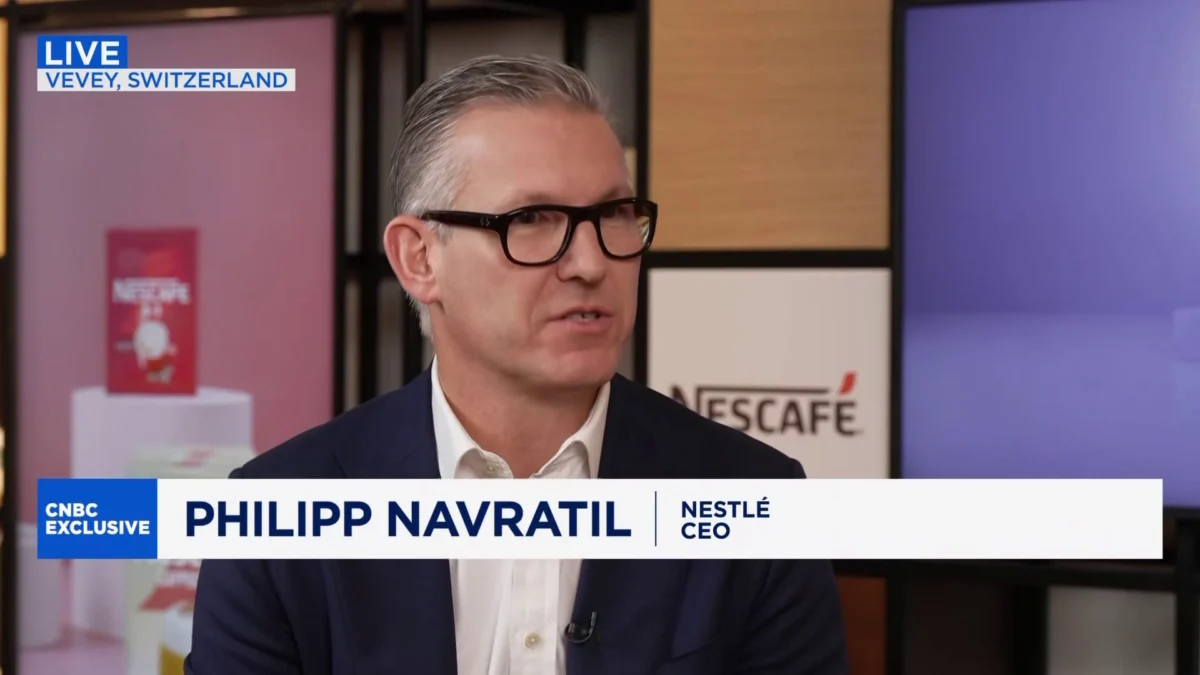
Nestlé CEO Philipp R. N. L. Navratil told CNBC that U.S. shoppers are stretched financially, describing the domestic market as unusually tough for consumer spending. His comments came during an interview focused on the company’s third-quarter performance, which Nestlé said exceeded analysts’ expectations.
In a discussion with CNBC’s Carolin Roth, the CEO highlighted three pressures shaping the business: slower U.S. consumer spending, faster sales growth in emerging markets, and ongoing restructuring in Russia. While exact figures were not provided in the summary, the conversation centered on how shifting consumer behavior is influencing the world’s largest food company.
KEY FACTS
- Nestlé CEO Philipp R. N. L. Navratil spoke with CNBC’s Carolin Roth.
- Third-quarter earnings were better-than-expected, per Nestlé.
- Growth was reported in emerging markets, according to the CEO.
- U.S. shoppers were described as cash-strapped and difficult to sell to.
- Deconsolidation in Russia was also discussed, the CEO said.
THE STORY
What happens next?
Nestlé’s third-quarter results arrived as consumer goods companies worldwide grapple with inflation and cautious household budgets. The CEO framed the U.S. market as particularly delicate, suggesting that price sensitivity among shoppers could limit volume growth even if branded products remain popular.
This dynamic matters because the United States represents one of Nestlé’s largest operating regions, and any sustained dip in demand can ripple through quarterly forecasts. At the same time, emerging markets offered a contrast, with the CEO pointing to expansion that helped offset some weakness elsewhere.
Looking ahead, investors will watch whether the company’s pricing strategy can hold margins steady without further alienating price-conscious buyers. The Russian restructuring — described as deconsolidation — remains another variable, especially as Western firms recalibrate operations in a changing geopolitical environment.
Who is affected?
Consumers, investors, and analysts are all tuned in. For everyday shoppers, Nestlé’s portfolio includes staples such as coffee, pet food, and infant nutrition, meaning shifts in demand can influence store-brand competition and promotional pricing.
Investors take cues from Nestlé’s earnings calls and leadership interviews as signals about the broader consumer discretionary cycle. If the U.S. shopper continues to pull back, it could prompt other multinational companies to adjust inventory and marketing plans accordingly.
The emerging-market growth story is likely to attract attention from portfolio managers tracking developing economies, where rising middle classes are increasingly spending on packaged foods. Meanwhile, the deconsolidation in Russia could affect how supply chains are structured globally, particularly in Europe and Asia.
How did we get here?
Nestlé’s quarterly results reflect a multi-year shift in global consumer behavior. Rising interest rates, sticky inflation, and wage growth that trails cost increases have all pressured household budgets, especially in advanced economies.
In the U.S., grocery spending has proven resilient but selective, with consumers trading down to cheaper brands or reducing frequency. That environment poses challenges for premium packaged-goods makers that rely on brand loyalty and regular repurchasing.
Emerging markets, by contrast, have shown renewed appetites for branded products as urbanization and digital commerce expand access. Russia’s situation adds complexity: Western sanctions and capital restrictions have pushed many companies to scale back or restructure local operations, a trend Nestlé appears to be navigating through its ongoing deconsolidation efforts.
WHAT WE KNOW — AND WHAT WE DON’T
Verified by the source:
- The Nestlé CEO is Philipp R. N. L. Navratil.
- The interview aired on CNBC with Carolin Roth.
- Third-quarter earnings exceeded expectations, per Nestlé.
- Growth was noted in emerging markets.
- U.S. consumers were described as financially constrained.
- Russia restructuring was characterized as deconsolidation.
Still unconfirmed:
- No specific third-quarter revenue or profit figures were cited.
- The timeline of the interview beyond “Q3” is not specified.
- Details on which emerging markets led growth are missing.
- No other company executives or board members were named.
- The financial terms of the Russian restructuring remain unclear.
WHY IT MATTERS
This interview offers a window into how major consumer staples firms are adapting to uneven global demand. Read more about shifting patterns in [economy-markets].
WHAT TO WATCH
Nestlé is expected to publish its full third-quarter financial report soon, which will clarify the scale of U.S. and emerging-market performance. Analysts will also be listening for updates on the pace of price increases and how the company plans to manage costs in the year ahead.