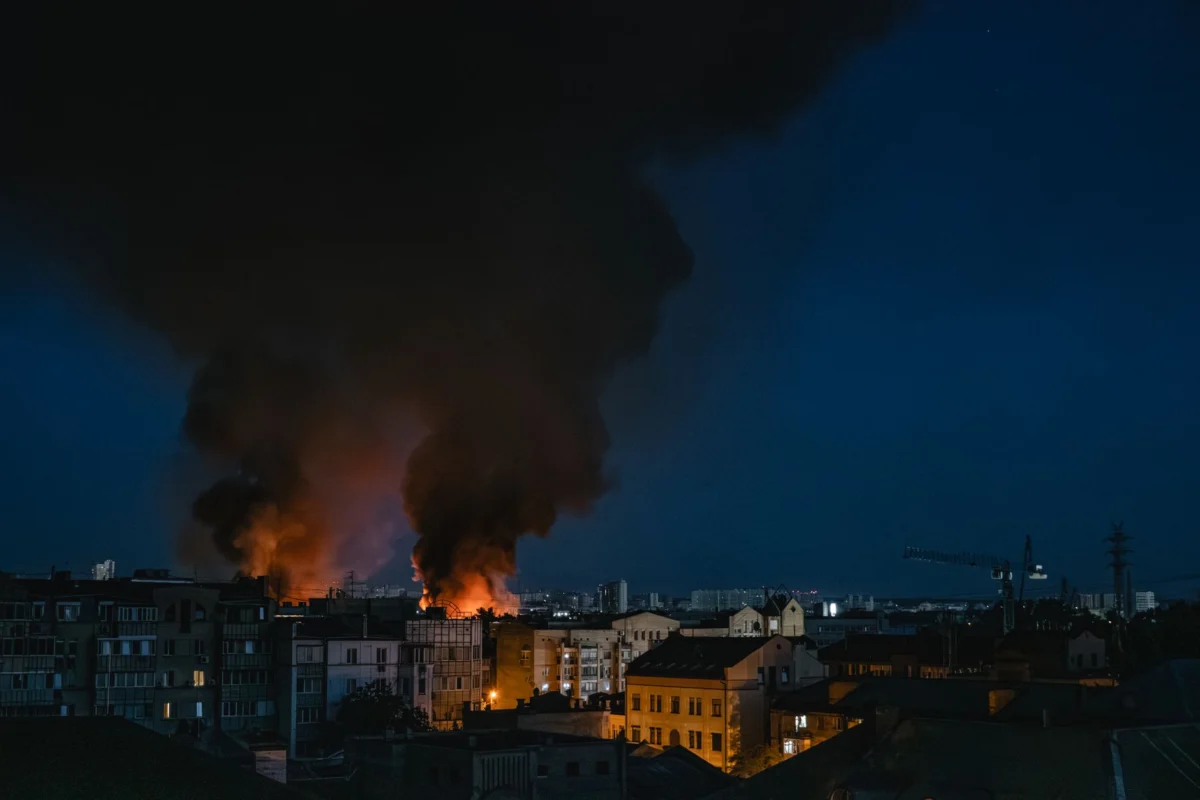
Kyiv residents woke to a dense gray blanket overhead after Russian airstrikes sent smoke and soot particles into the air that combined with moisture, creating an unusual fog-like effect over the war-ravaged capital.
The phenomenon, driven by fine particulates from explosions mixing with humidity, reduced visibility across the city as authorities and residents processed another night of coordinated attacks.
KEY FACTS
- Smoke and soot from Russian airstrikes left particles in the air.
- Those particles combined with moisture to form a dense gray blanket over Kyiv.
- The blanket covered Ukraine’s war-ravaged capital, an unusual meteorological effect.
WHAT IS THE KYIV FOG EFFECT?
The visible haze reported over Kyiv is best understood as a form of aerosol fog or pollution smog, in which airborne particles act as condensation nuclei for water vapor. When soot and smoke from explosive detonations mix with ambient moisture, the resulting mixture can scatter light and lower visibility in a manner similar to conventional fog, but with a gray or brownish tint caused by the particulate matter itself.
Meteorologists note that such effects depend on temperature, humidity, and the concentration of fine particles suspended in the air. In wartime conditions, repeated strikes can sustain elevated particle levels, prolonging the smoky haze well beyond the immediate blast zones. The phenomenon underscores how conflict can produce indirect environmental consequences alongside direct damage.
For residents, the distinction between natural fog and smoke-laden air may matter for health guidance, since inhaling combustion byproducts carries different risks than breathing clean, moisture-heavy air. Officials typically advise limiting exposure during such conditions, though specific public health instructions were not detailed in the source.
HOW DID WE GET HERE?
The appearance of this unusual meteorological effect follows a pattern in which explosive detonations release large quantities of carbon-based particles into the atmosphere. These particles remain suspended and interact with natural atmospheric processes, altering local visibility and air quality. The source describes strikes whose smoke and soot contributed directly to the formation of the gray blanket.
This sequence has occurred repeatedly in conflicts where urban areas face sustained aerial bombardment, as fine particulates accumulate faster than dispersal mechanisms can clear them. Each wave of strikes can deepen and extend the haze, linking the visual signature of warfare to broader environmental and meteorological changes. The result is a feedback loop where more explosions produce more particles, which then linger and affect conditions even after the immediate attacks end.
Understanding the interaction between combat activity and atmospheric behavior helps explain why some wartime conditions persist in ways that extend beyond physical destruction. The blending of human-caused emissions with natural moisture cycles demonstrates how warfare can reshape not only infrastructure but also the skyline and air that civilians must breathe.
WHAT WE KNOW — AND WHAT WE DON’T
Verified by the source:
- Smoke and soot from Russian airstrikes left particles in the air over Kyiv.
- Those particles combined with moisture to form a dense gray blanket.
- The effect was described as unusual and related to wartime conditions.
- The area affected was identified as Ukraine’s war-ravaged capital.
Still unconfirmed:
- The exact time or duration of the strikes.
- The number of airstrikes involved.
- Official health or air quality warnings issued.
- The specific altitude or geographic boundaries of the haze layer.
WHY IT MATTERS
The formation of an artificial fog from wartime emissions highlights how conflict can indirectly alter daily life and environmental conditions, affecting visibility, air quality, and public health even for people sheltering far from blast sites. Such effects illustrate the broader ecological footprint of war, extending beyond buildings and infrastructure to the very atmosphere surrounding civilians.
WHAT TO WATCH
Future developments may include whether similar effects recur with subsequent strike waves, and whether authorities issue public guidance on exposure during such conditions. Monitoring of air quality data could confirm the persistence and dispersion of the particle layer over coming days.
Kyiv fog effect: smoke and soot from Russian airstrikes mixed with moisture to create a dense gray blanket over Ukraine’s capital, producing an unusual wartime meteorological phenomenon.
Explore more coverage under war-geopolitics and climate-environment.