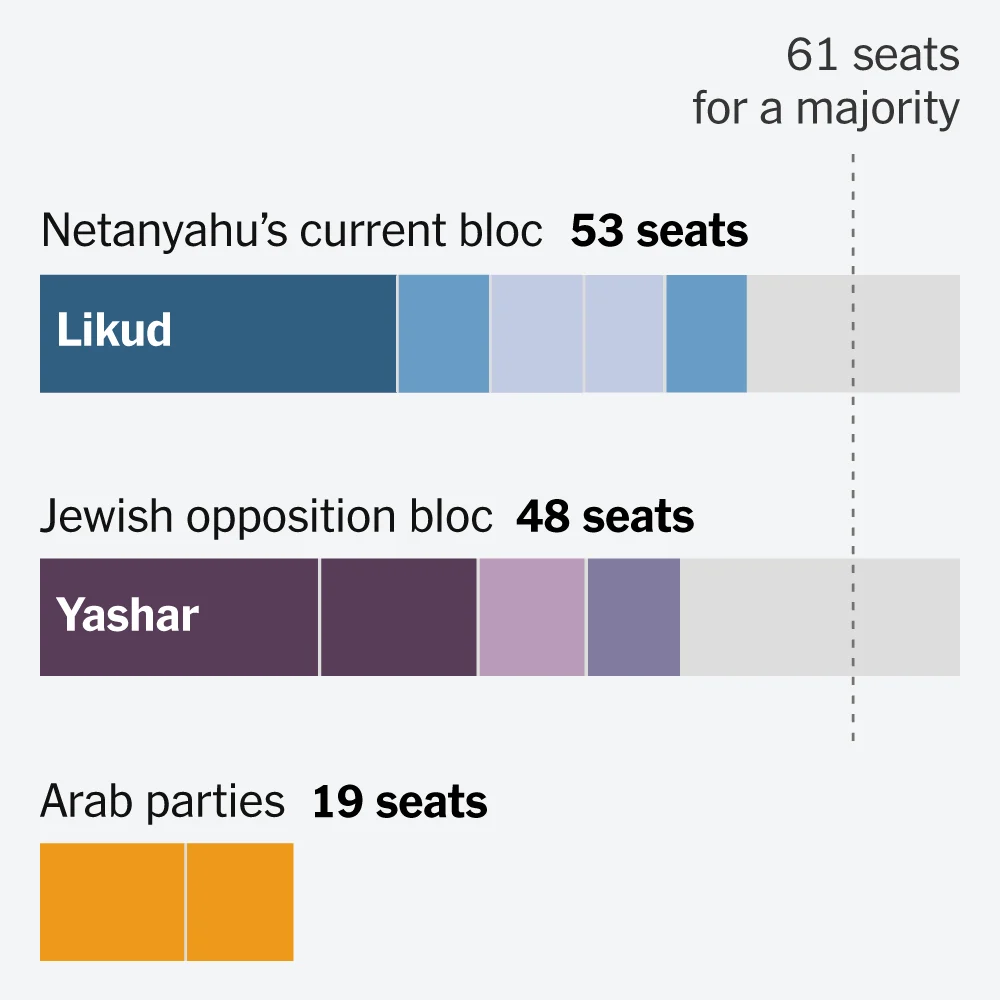
Israel faces significant challenges in forming a government after an election resulted in a deadlock with no clear winner between Prime Minister Benjamin Netanyahu’s bloc and the main challenger. Despite neither side securing a majority, multiple paths remain for establishing a new government through coalition negotiations and political maneuvering.
The deadlock situation reflects broader political fragmentation in Israel, where no single party or bloc has been able to secure enough seats to form a majority government independently. This creates a complex environment for government formation, requiring extensive behind-the-scenes negotiations between various political parties and leaders.
KEY FACTS
- Deadlock is possible as neither Benjamin Netanyahu‘s bloc nor the main challenger won a majority.
- Multiple paths exist for forming a new government despite the deadlock.
- The situation involves coalition-building scenarios rather than a simple two-party contest.
The Story
Who is affected by this deadlock?
Voters, political parties, and citizens across Israel are directly affected by the government formation uncertainty. The ongoing political instability impacts policy decisions, economic planning, and international relations as the country operates without a clear mandate from the electorate.
Political analysts note that Israel’s proportional representation system often leads to fragmented parliaments where no single party wins an outright majority. This necessitates coalition governments, which require months of negotiations between parties to form. The current deadlock is consistent with this historical pattern of Israeli politics.
What happens next?
Incoming government formation efforts will likely involve intensive negotiations between party leaders, potential defections, and strategic alliances designed to piece together a majority coalition capable of passing legislation and maintaining stability in the Knesset.
President Isaac Herzog typically plays a key role in this process by tasked formateurs with the responsibility of attempting to build a viable governing coalition. These efforts can take several weeks or even months to conclude successfully.
What We Know — and What We Don’t
Verified by the source:
- Deadlock is possible as neither bloc secured a majority.
- Paths still exist for forming a new government.
- The main contenders include Prime Minister Benjamin Netanyahu and his primary opponent.
Still unconfirmed:
- Which specific coalition partners might emerge.
- Timeline for resolving the deadlock.
- Exact seat counts and vote margins.
- Identity of any third-party mediators.
Why It Matters
Government formation uncertainty in Israel affects regional stability, diplomatic relationships, and domestic policy implementation. As a key ally in the Middle East, Israel’s internal political dynamics carry substantial weight in broader geopolitical discussions and security matters.
What To Watch
The coming weeks will reveal whether negotiators can assemble a functional coalition or whether new elections eventually become necessary to resolve the deadlock.