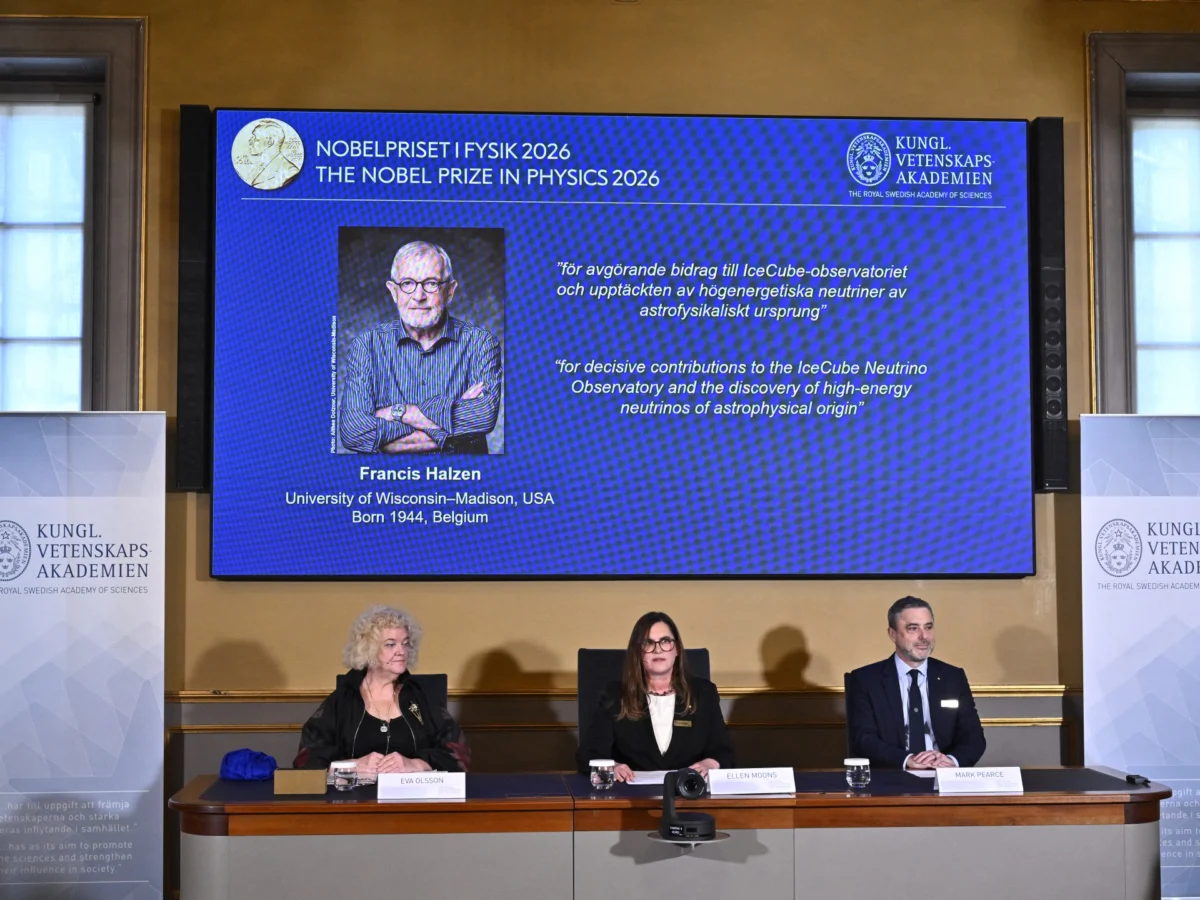
Francis Halzen has been awarded the Nobel Prize in Physics for his groundbreaking work studying neutrinos, often referred to as ‘ghost particles’ due to their elusive nature. His research centered on constructing an Antarctic observatory designed to detect these subatomic particles originating from deep space.
This achievement highlights decades of international scientific collaboration focused on understanding some of the universe’s most mysterious components. The Nobel Committee recognized Halzen’s contributions as pivotal in advancing humanity’s knowledge of particle physics and astrophysics.
Key Facts
- Nobel Prize in Physics awarded to Francis Halzen.
- Halzen is a Belgian physicist.
- He contributed to building an observatory in Antarctica.
- The facility tracks neutrinos, known as ‘ghost particles’.
- These particles originate from deep space.
What Are Ghost Particles and Why Do They Matter?
Neutrinos, nicknamed ‘ghost particles’, rarely interact with matter, making them extraordinarily difficult to detect. Scientists estimate trillions pass through our bodies every second without interaction. Studying them offers insights into stellar processes, supernovae, and the early universe.
The Antarctic location provides ideal conditions: thick ice shields out cosmic interference while preserving sensitive equipment. This environment enables precise measurements of neutrino behavior, helping decode cosmic phenomena otherwise invisible to astronomers.
How Did We Get Here?
Building the observatory required international funding and engineering expertise. Teams worked under harsh polar climates to install detectors beneath the ice sheet. Decades of refinement led to breakthroughs confirming theoretical predictions about neutrino oscillations and mass differences.
Halzen’s leadership helped transform abstract particle theory into observable science, marking a milestone in experimental physics. His work bridges quantum mechanics and cosmology, opening new frontiers for exploration.
What Happens Next?
Future projects aim to expand detection capabilities using upgraded technology. Plans include deeper excavations and enhanced sensors to capture even fainter signals. These advancements may reveal previously unknown particle behaviors tied to dark matter or exotic astrophysical events.
Collaboration among global institutions continues strengthening infrastructure supporting long-term studies. Ongoing data collection promises further discoveries reshaping fundamental understanding of nature’s smallest constituents.
What We Know — and What We Don’t
Verified by the source:
- Francis Halzen won the Nobel Prize in Physics.
- He worked on constructing an Antarctic observatory.
- The observatory detects neutrinos (‘ghost particles’) from space.
- He is identified as a Belgian physicist.
Still unconfirmed:
- Exact year the prize was awarded.
- Collaborators involved in the project.
- Technical specifications of the observatory.
- Scientific implications detailed beyond summary.
Why It Matters
Neutrino research pushes boundaries of human knowledge, linking microscopic quantum effects with macroscopic cosmic structures. Discoveries rooted in fundamental science often yield unexpected applications—from medical imaging to nuclear safety—demonstrating how curiosity-driven inquiry fuels innovation across disciplines.
What To Watch
Further announcements regarding upcoming expansions or follow-up experiments might emerge soon. Official statements detailing collaborative efforts or future goals could provide additional context.