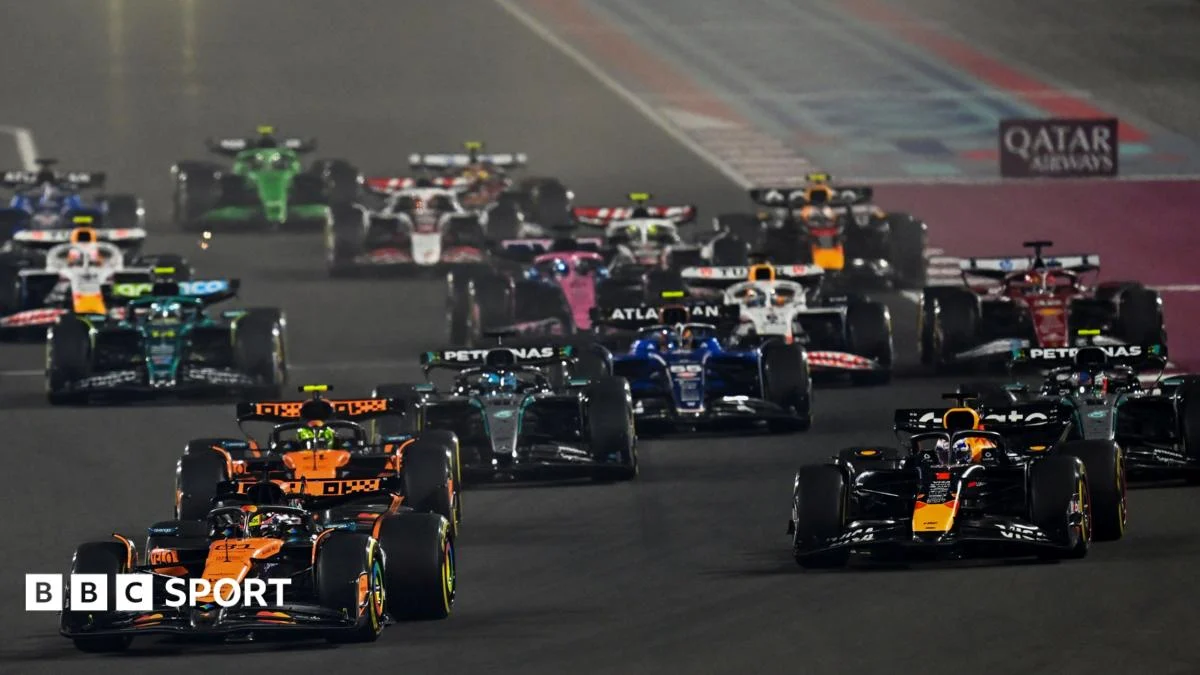
Formula 1 drivers will be limited to a maximum of 27 laps on a single set of tyres during next weekend’s Qatar Grand Prix. The restriction, confirmed by the sport’s governing body, applies to every compound and aims to manage the high thermal demands placed on tyres at the Losail International Circuit.
The mandate effectively forces at least three pit stops in a standard race distance, reshaping strategic calculations for teams that had planned longer stints. It marks a rare instance where the FIA imposes a hard stint limit rather than leaving tyre management entirely to the teams.
Key Facts
- Drivers limited to 27 laps per tyre set at the Qatar Grand Prix
- Rule applies to all tyre compounds available for the weekend
- Mandate issued by the FIA ahead of the race weekend
- Minimum three pit stops now effectively required
- Decision driven by tyre safety concerns at Losail International Circuit
How the Limit Changes Race Strategy
The 27-lap cap removes the option of extended runs that teams often use to gain track position or save a pit stop. At Losail’s 5.38-kilometre layout, 27 laps equals roughly 145 kilometres — well short of the 306-kilometre race distance. Even with the hardest compound, no driver can cover more than about half the race on one set.
Strategists must now build around three or four stops, increasing the importance of pit-lane efficiency and traffic management. The rule also reduces the advantage of teams with superior tyre degradation, since nobody can push a set to its structural limit. Overtaking opportunities may rise as drivers run qualifying-style pace on fresh rubber more frequently.
Why the FIA Stepped In
High-speed corners and abrasive asphalt at Losail generate extreme tyre surface temperatures. During pre-season testing and previous editions, several teams reported blistering and structural fatigue well before the 30-lap mark. The FIA’s single-seater technical department analysed telemetry from those sessions and concluded that a mandatory limit was the safest way to prevent catastrophic failures.
Similar interventions have occurred at other high-load circuits such as Qatar’s neighbour Bahrain and the United States Grand Prix at Austin. In each case the limit was published before the weekend, giving teams time to simulate the new stop patterns. The governing body retains the right to adjust the number after Friday practice if real-world data differs from projections.
What We Know — and What We Don’t
Verified by the source:
- Maximum stint length set at 27 laps for the Qatar Grand Prix
- Limit applies to every dry-weather compound supplied by Pirelli
- Rule takes effect for the upcoming race weekend
Still unconfirmed:
- Whether the limit could be revised after Friday or Saturday running
- Exact penalty for exceeding the 27-lap maximum
- How wet-weather tyres are treated if rain interrupts the race
- Team-by-team reaction or strategic simulations
Why It Matters
The mandate illustrates how safety-driven regulation can override pure competition logic. Fans will see more pit stops and potentially more varied strategies, while teams lose a degree of tactical freedom. For the championship, the rule could shuffle the competitive order at a circuit where tyre management has historically separated the frontrunners.
What to Watch
Friday practice will reveal whether the 27-lap figure holds or if the FIA adjusts it based on actual tyre wear data. Qualifying trim and race simulations on the three compounds will show which teams adapt fastest to the compressed stint window.