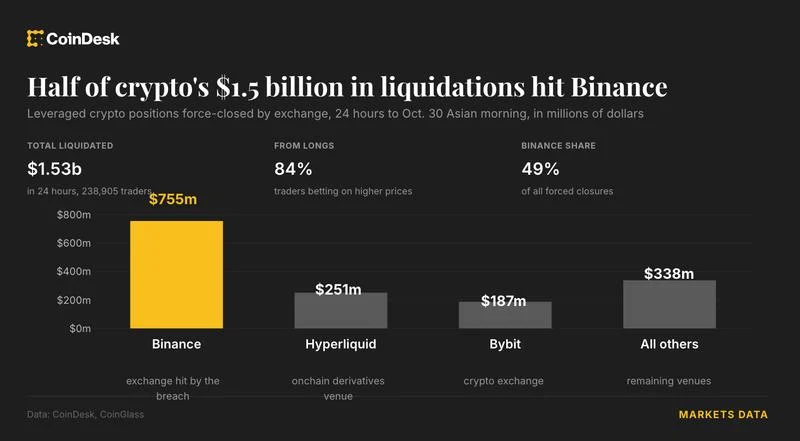
A sudden price drop across Bitcoin, Ether, and XRP triggered an estimated $1.5 billion in liquidations of leveraged crypto bets, wiping out positions that had amplified market exposure.
The losses came largely from traders using borrowed funds to place leveraged bets, a strategy that magnifies both gains and losses. As prices fell, exchanges automatically closed these positions, accelerating the market move and catching more participants off guard.
Key Facts
- $1.5 billion in leveraged crypto bets were wiped out by the selloff.
- 84% of forced closures were bets on rising prices.
- Binance handled almost half of the total forced closures.
- A rebound has since begun, catching short sellers off guard.
What happens next?
After the initial crash, markets showed signs of stabilization, with a rebound beginning to form. This recovery caught short sellers — traders betting on further price declines — in a difficult position, as their leveraged positions faced fresh pressure from rising prices.
The rebound suggests that while the immediate selloff cleared out risky leveraged positions, underlying demand may still be present. However, the volume and sustainability of this bounce remain unclear without additional data on trading activity and open interest.
Market participants are now watching whether the rebound can hold, or if another wave of volatility will trigger further liquidations. The interplay between long and short positions continues to shape price action in crypto markets.
Who is affected?
Leveraged traders bore the brunt of the selloff, particularly those who had bet on rising prices. These individuals often use margin accounts or derivative contracts that allow them to control large positions with relatively small capital — but the flip side is that losses are amplified when markets move against them.
Binance, one of the world’s largest crypto exchanges, processed nearly half of all forced closures during the event. This underscores the role of major platforms in managing high-leverage trading activity and the systemic impact when large volumes of positions are liquidated at once.
Retail and institutional investors alike use leveraged products, though institutions typically employ hedging strategies to limit downside risk. Still, the ripple effects of mass liquidations can influence broader market sentiment and pricing across digital assets.
How did we get here?
Leveraged trading has become increasingly common in cryptocurrency markets, driven by the promise of outsized returns in a highly volatile asset class. Traders often borrow funds to increase their buying power, but this also increases the likelihood of forced closures when prices move sharply.
The recent selloff affected Bitcoin, Ether, and XRP — three of the most liquid cryptocurrencies. When these assets declined rapidly, it triggered a cascade of margin calls and automatic position closures across trading platforms. This kind of chain reaction is typical in leveraged markets and can deepen price swings in both directions.
CoinDesk: Bitcoin, Ethereum, Crypto News and Price Data reported that nearly 84 percent of the forced closures involved bets on rising prices, indicating that bullish sentiment had been heavily concentrated just before the crash.
What We Know — and What We Don’t
Verified by the source:
- The total value of wiped-out leveraged crypto bets was $1.5 billion.
- 84% of forced closures were long positions betting on rising prices.
- Binance handled almost half of the total forced closures.
- A rebound has started, affecting short sellers.
Still unconfirmed:
- The exact timing or duration of the rebound.
- Which specific cryptocurrencies led the selloff.
- Total number of affected traders or platforms.
Why It Matters
Leveraged trading plays a central role in shaping cryptocurrency market dynamics. When large volumes of positions are liquidated, it can amplify price swings, impact investor confidence, and influence how quickly markets recover. Understanding these events helps both new and experienced traders navigate the risks of margin-based investing.
What To Watch
Traders will be watching whether the current rebound continues or if renewed volatility emerges. Additional data from exchanges and derivatives platforms may provide further clarity on the health of leveraged positions moving forward.
Crypto liquidation data reflects the fragility of leveraged trading in volatile markets.
For ongoing updates on digital asset markets, visit the trading-crypto section or explore our economy and markets archive.