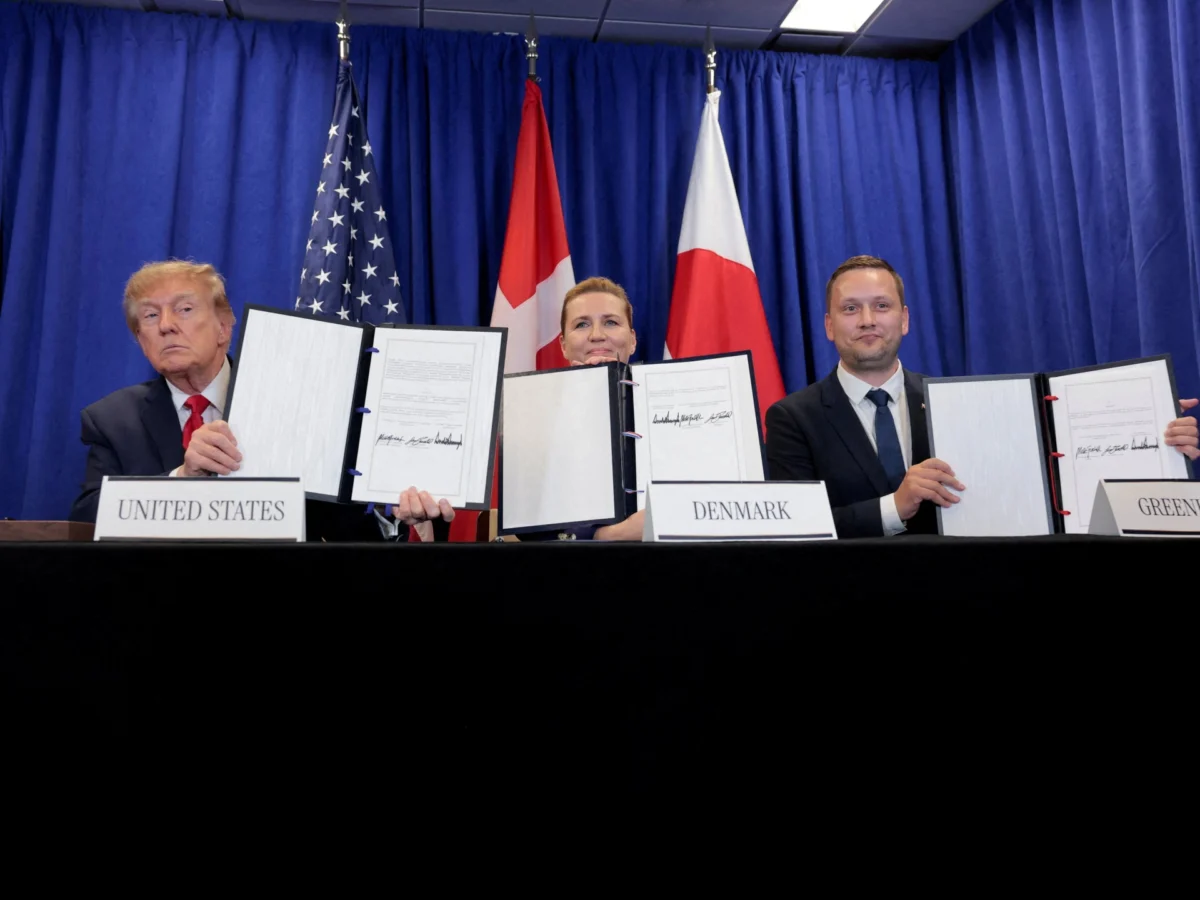
A US-Denmark-Greenland security deal was signed allowing expanded US military presence in Greenland. Trump and the leaders of Denmark and Greenland signed the agreement, which was described as ‘tremendous’ by officials involved. The deal marks a significant shift in Arctic security arrangements and strengthens US strategic reach in a geopolitically sensitive region.
The agreement enables greater US military access to Greenland, whose territory sits between North America and Europe and includes areas near the Arctic Circle. That positioning gives the United States improved surveillance and logistical options in the Arctic, where melting ice is opening new shipping routes and increasing great-power competition. While the signing ceremony was confirmed, the specific terms of the expanded presence remain undisclosed, including the scale of personnel or equipment deployments permitted under the deal.
KEY FACTS
- Agreement signed: Trump and leaders of Denmark and Greenland signed a security deal.
- Military expansion: The deal allows for an expanded US military presence in Greenland.
- Characterization: The deal was described as ‘tremendous’ by those involved.
- Source: Reported by Al Jazeera – Breaking News, World News and Video from Al Jazeera.
- Region: Greenland’s location near the Arctic Circle is central to the agreement’s strategic value.
WHAT HAPPENS NEXT?
After the signing, the practical implementation of the US-Denmark-Greenland security deal will depend on coordination between the parties. The United States has not specified when or how the expanded military presence will begin. Details such as base construction, personnel numbers, or operational timelines remain unconfirmed. NATO allies and Arctic stakeholders are likely watching closely, as any increase in US military activity in Greenland could prompt diplomatic responses or policy adjustments from other regional actors.
Greenland itself is an autonomous territory within the Kingdom of Denmark, meaning both Copenhagen and Nuuk hold authority over different aspects of governance and defense. Any long-term US military buildup would require alignment with Danish constitutional obligations and Greenlandic local policies. Past US interest in Greenland has included proposals for acquisition, though this agreement appears focused on access rather than ownership. Environmental and infrastructure challenges in the Arctic also complicate large-scale operations.
HOW DID WE GET HERE?
The US-Denmark-Greenland security deal builds on long-standing defense cooperation between the United States and Denmark. Denmark is a NATO member and hosts US forces at bases in Europe, while Greenland has hosted the US Air Force at Thule Air Base since the 1950s. That base remains one of the northernmost US installations in the Western Hemisphere and plays a role in missile warning and surveillance operations. Recent years have seen renewed attention to Arctic security, driven by climate change and increased military activity by Russia and China, prompting the United States to seek stronger footholds in the region.
Greenland’s leadership has previously expressed interest in diversifying economic and security partnerships amid growing geopolitical interest in the island. At the same time, Denmark has balanced its NATO commitments with respect for Greenlandic autonomy. The newly signed deal reflects a convergence of these interests, offering the United States expanded access while preserving existing political frameworks. The exact scope of future cooperation remains undefined, leaving questions about budget allocations, legal agreements, and local consent processes.
WHAT WE KNOW — AND WHAT WE DON’T
Verified by the source:
- A security deal was signed between the United States, Denmark, and Greenland.
- The deal allows for an expanded US military presence in Greenland.
- The deal was described as ‘tremendous’ by those signing or announcing it.
- The report originates from Al Jazeera – Breaking News, World News and Video from Al Jazeera.
- Greenland’s Arctic location is cited as relevant to the deal’s significance.
Still unconfirmed:
- The specific terms, duration, and legal structure of the agreement.
- The number of additional US troops or units permitted under the deal.
- Whether new infrastructure or bases will be constructed in Greenland.
- Reactions from other NATO members or Arctic Council participants.
- The role of Greenlandic domestic politics or Danish parliamentary approval.
WHY IT MATTERS
This deal reflects the growing strategic importance of the Arctic, where climate change is reshaping security dynamics. A stronger US military presence in Greenland could enhance monitoring of air and maritime traffic, support allied operations across the North Atlantic, and counterbalance increasing influence from competitors. For Greenland and Denmark, the agreement offers potential economic benefits and reinforced defense ties without ceding sovereignty. The broader implications will unfold as implementation details emerge and regional powers respond.
WHAT TO WATCH
Further statements from US, Danish, and Greenlandic officials may clarify the scope and timeline of the expanded presence. Monitoring will also include responses from NATO allies and Arctic partners as the geopolitical landscape evolves.