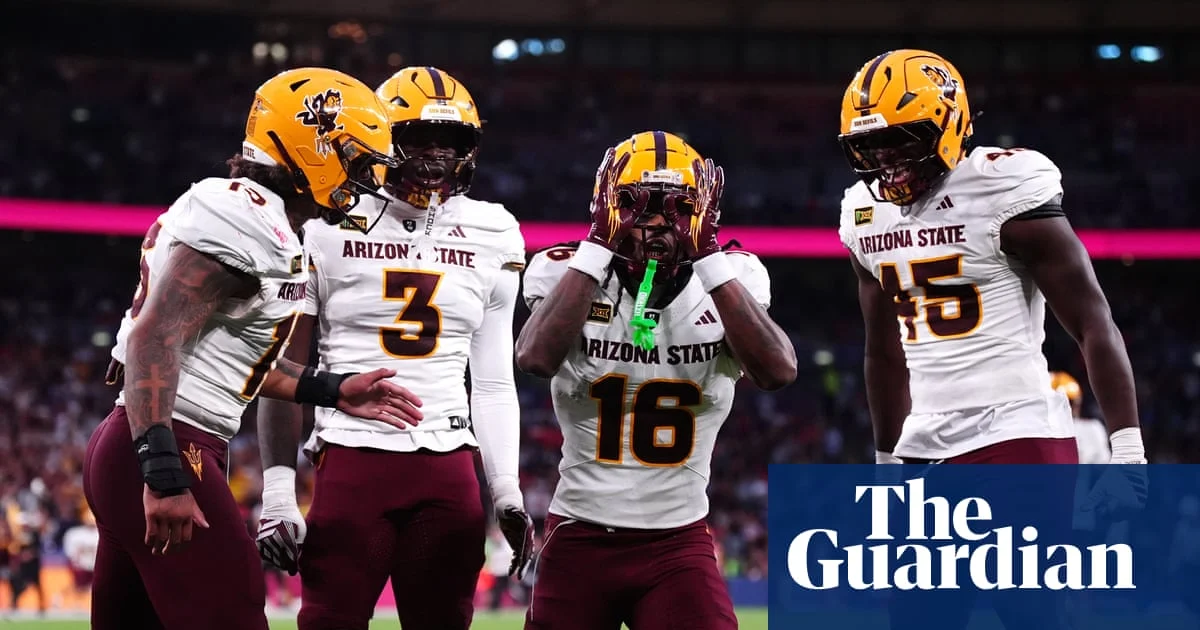
The inaugural Union Jack Classic college football game at Wembley Stadium produced a convincing win for the Arizona State Sun Devils, but failed to generate widespread enthusiasm on the field despite an electric atmosphere fueled largely by a spirited marching band. The match marked Britain’s first US college football game in nearly four decades, yet visible evidence of limited ticket uptake — with thousands of empty seats — underscored its muted commercial impact.
Kickoff was preceded by pregame energy from the Arizona State Sun Devils’ marching band, whose brass and percussion section activated Wembley Way with a performance that echoed across the concourses, contributing to a charged pregame mood that contrasted with the sparsely filled stands. While the Sun Devils secured a victory, the broader reception suggested strong ceremonial spectacle over substantive football passion.
KEY FACTS
- Arizona State Sun Devils won the first Union Jack Classic college football game.
- The game took place at Wembley Stadium in London.
- Attendance was marked by thousands of empty seats, indicating lower-than-expected turnout.
- Britain’s first US college football game in nearly 40 years was held during this event.
- An energetic marching band contributed to the pregame atmosphere outside Wembley.
WHAT WAS THE RECEPTION?
The Union Jack Classic opened with pageantry rather than polish. The Arizona State Sun Devils’ marching band dominated the pregame experience, filling Wembley Way with brass, percussion, and crowd energy hours before kickoff. According to observers, the band’s animated performance — with horns and trombones sweeping side to side — created an “electric atmosphere,” even as the stands remained partially vacant throughout the game.
Despite the team’s victory, the lack of full attendance called into question whether the event successfully converted novelty into genuine fan engagement. The contrast between loud entertainment and half-empty sections highlighted a disconnect between ceremonial excitement and broader cultural appeal.
WHAT HAPPENS NEXT?
Organizers have not yet announced plans for future installments of the Union Jack Classic. The game’s mixed reception may influence decisions around repeat hosting and fan outreach strategies. With college football having returned to British soil after nearly 40 years, stakeholders will likely evaluate metrics such as ticket sales, broadcast reach, and local response.
For now, the Union Jack Classic remains a singular moment — a curiosity that drew attention but struggled to sustain momentum beyond its soundtrack. Whether the format evolves into a recurring fixture or stands alone as a one-off experiment depends largely on post-event analysis still unseen by the public.
WHAT WE KNOW — AND WHAT WE DON’T
Verified by the source:
- Arizona State Sun Devils won the inaugural Union Jack Classic.
- The game occurred at Wembley Stadium in London.
- Britain’s first US college football game in nearly 40 years was played during this event.
- Thousands of seats were empty during the game.
- The Sun Devils’ marching band played outside Wembley before kickoff.
Still unconfirmed:
- The actual attendance figures or percentage of capacity used.
- The final score or statistical performance of either team.
- Whether future Union Jack Classics are planned.
- Exact year of the last US college football game played in Britain.
- Quotes or official commentary from organizers or attendees.
WHY IT MATTERS
Events like the Union Jack Classic represent attempts to expand global audiences for American football, tapping into international markets where traditional sports dominate. Their success or failure can shape long-term expansion efforts by US collegiate programs seeking new revenue streams and cultural relevance abroad. As universities weigh international partnerships, these exhibition games serve as test cases for cross-cultural sports diplomacy and brand extension. The outcome also reflects how niche sports adapt—or fail to adapt—to regions with entrenched athletic preferences. Whether viewed as novelty or opportunity, the game signals growing interest in diversifying global sporting landscapes, even amid inconsistent reception.
WHAT TO WATCH
Organizers have yet to disclose whether the Union Jack Classic will return, leaving fans uncertain about its future. Final attendance data and official evaluations, if released, would clarify whether the game achieved its broader ambitions.