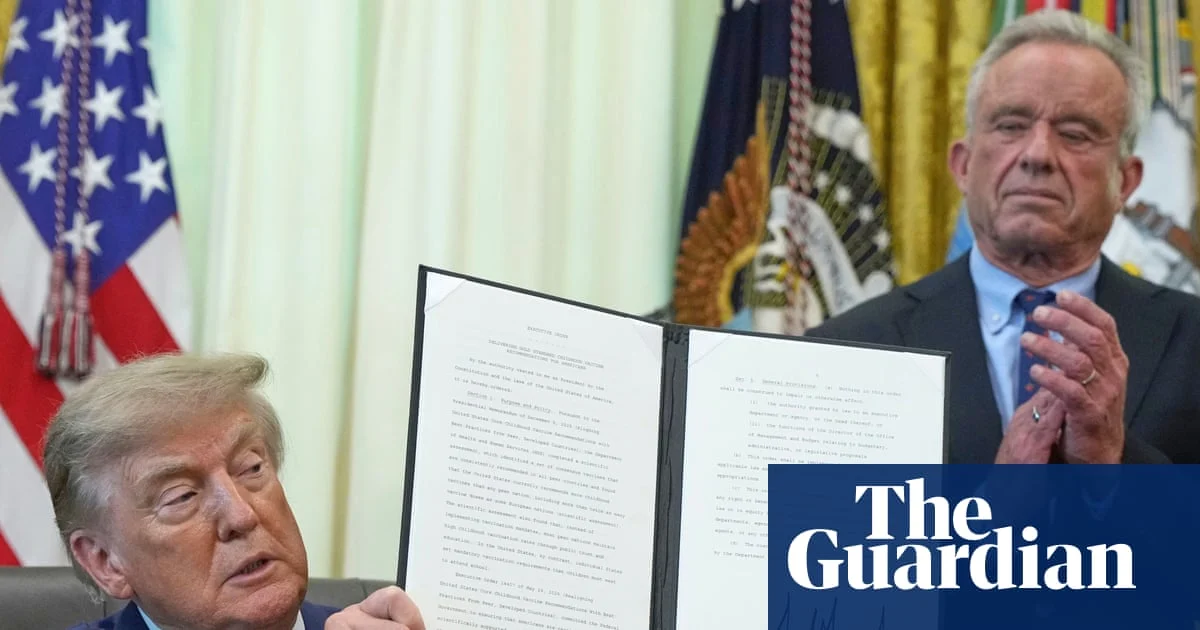
President Donald Trump has signed an executive order attempting to make sweeping changes to childhood vaccination schedules, overriding the authority of the Centers for Disease Control and Prevention (CDC). The order, signed alongside Health Secretary RFK Jr., referenced concerns about autism, despite scientific studies showing no link between vaccines and autism.
The CDC, not the White House, is the federal agency responsible for issuing vaccine recommendations. This move follows previous changes to CDC vaccination recommendations that were later halted by a federal judge.
KEY FACTS
- President Trump signed an executive order to alter the U.S. childhood vaccine schedule.
- The order attempts to override CDC authority on vaccine recommendations.
- Trump and RFK Jr. mentioned autism during the signing, despite no scientific evidence linking it to vaccines.
- Earlier CDC vaccination changes were blocked by a federal judge.
- The CDC, not the White House, is responsible for vaccine guidelines.
What changes are being proposed?
The executive order aims to break up the MMR (measles, mumps, and rubella) vaccine into individual shots, despite longstanding medical consensus supporting their combination. Such a change would depart from standard CDC recommendations, which prioritize public health efficiency and safety.
How does this impact parents?
If enacted, this could create confusion among parents and healthcare providers, as CDC guidance has long been the gold standard for immunization schedules. Deviations from the established schedule could lead to lower vaccination rates and increased outbreaks of preventable diseases.
WHAT WE KNOW — AND WHAT WE DON’T
Verified by the source:
- Trump signed an executive order attempting to change childhood vaccination schedules.
- The order seeks to bypass CDC authority on vaccine recommendations.
- Trump and RFK Jr. invoked autism concerns, despite scientific evidence to the contrary.
Still unconfirmed:
- Whether the order will withstand legal challenges.
- How medical professionals will respond to these changes.
- The immediate real-world impact on vaccination rates.
WHY IT MATTERS
Vaccine policies directly affect public health, particularly in preventing outbreaks of diseases like measles and whooping cough. Overriding CDC recommendations could create inconsistencies in immunization practices, potentially leading to lower vaccination rates and increased disease risks.
WHAT TO WATCH
The order is likely to face legal scrutiny, similar to previous attempts to change CDC guidelines. Public health experts may also push back against any deviations from evidence-based vaccine schedules.