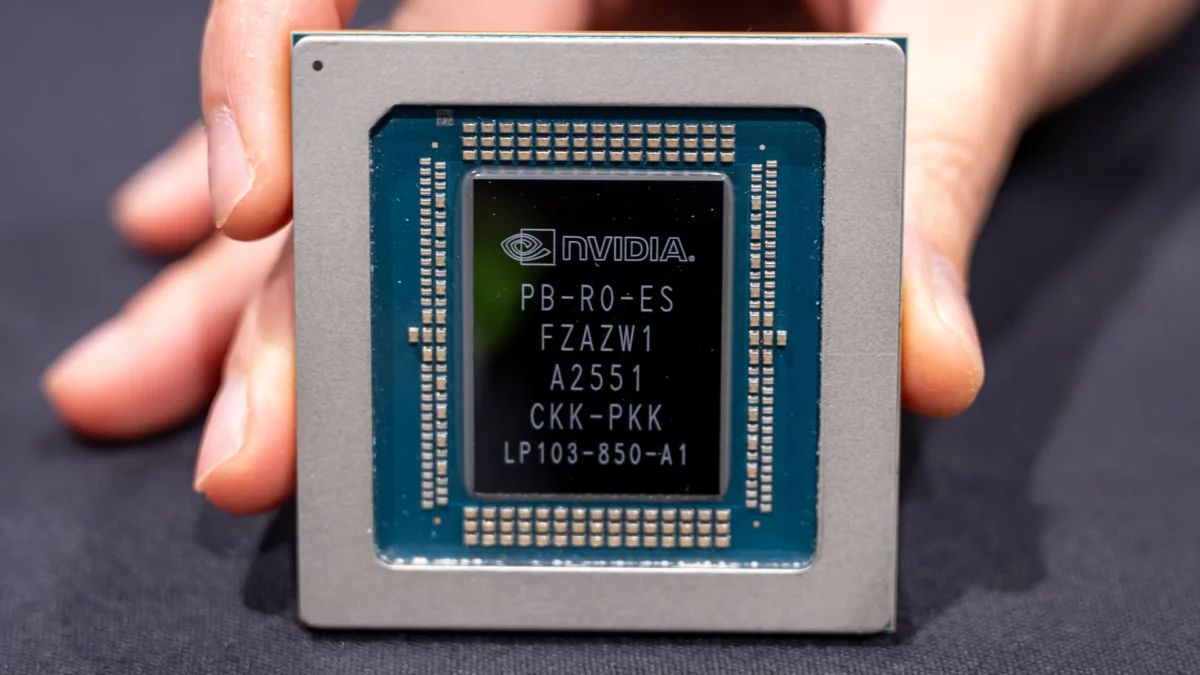
Nvidia has announced that Groq racks will be operational by the end of this year following its $20 billion purchase, accelerating its push into low-latency AI inference technology. The deal underscores the growing demand for faster AI processing as companies compete to deploy advanced machine learning models.
The acquisition positions Nvidia to expand its dominance in AI hardware, particularly in real-time inference applications. Groq’s architecture is designed to minimize delays in AI computations, a critical factor for industries requiring instant decision-making.
KEY FACTS
- Nvidia will deploy Groq racks this year after a $20 billion acquisition.
- The move emphasizes the importance of low-latency inference in AI development.
- Groq’s technology specializes in reducing delays in AI processing.
WHAT DOES THIS MEAN FOR THE AI CHIP MARKET?
Nvidia’s investment in Groq signals a strategic shift toward optimizing AI inference, the stage where trained models generate predictions. While Nvidia already leads in AI training hardware, Groq’s architecture could give it an edge in latency-sensitive applications like autonomous vehicles, financial trading, and real-time language processing.
The deal also reflects broader industry trends as AI deployments move from research to production. Companies increasingly need hardware that can deliver rapid, reliable inferences at scale, creating a new battleground for chip manufacturers.
WHAT WE KNOW — AND WHAT WE DON’T
Verified by the source:
- Nvidia acquired Groq for $20 billion.
- Groq racks will be online by year’s end.
- The focus is on low-latency AI inference.
Still unconfirmed:
- Specific performance benchmarks for Groq’s technology.
- Which industries or customers will deploy the racks first.
- How the acquisition affects Nvidia’s existing product lines.
WHY IT MATTERS
Faster AI inference unlocks new applications across industries, from healthcare diagnostics to interactive AI assistants. Nvidia’s move could reshape competitive dynamics in the semiconductor sector, where rivals like AMD and Intel are also racing to improve inference efficiency.
WHAT TO WATCH
Industry observers will monitor Groq rack deployment timelines and early performance reports. The deal’s success may hinge on whether Nvidia can integrate Groq’s technology while maintaining its current market momentum in AI hardware.