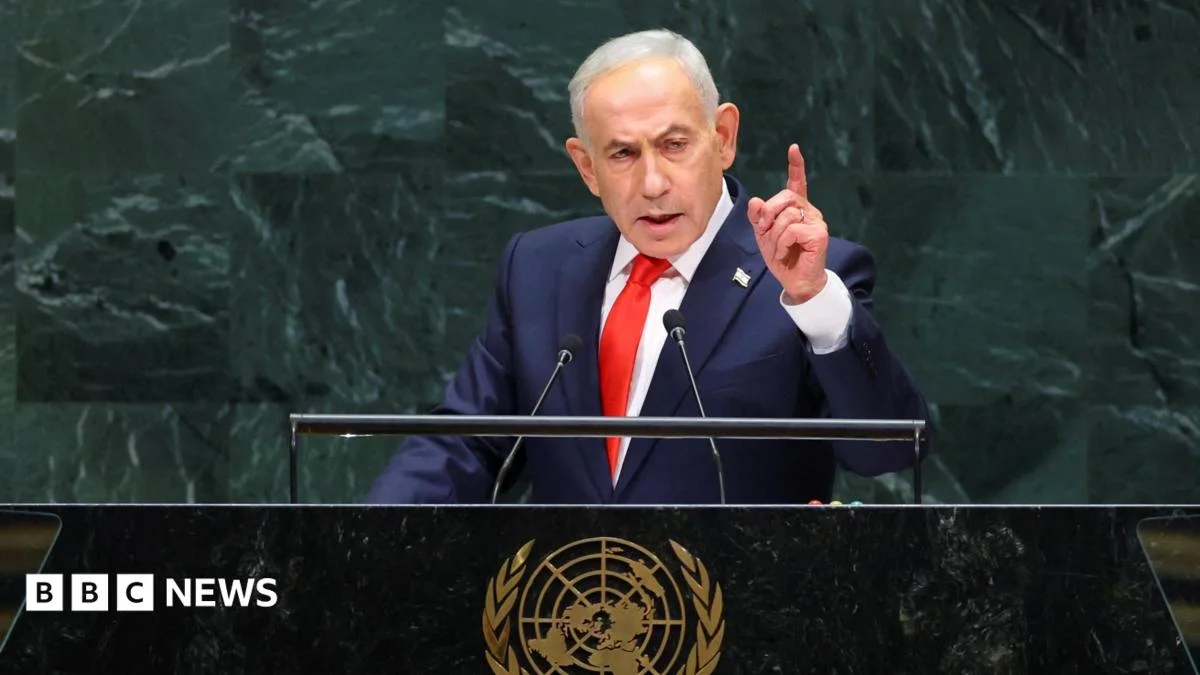
Israeli Prime Minister Benjamin Netanyahu defended Israeli military action during his address to the United Nations General Assembly, after several delegates walked out of the speech. He referred to those who left as “moral cowards,” according to BBC News.
The event underscores ongoing international tension surrounding Israel’s military operations and diplomatic relations at the UN. Delegates exiting during a speech is a rare and symbolic gesture, often signaling strong disagreement with the speaker’s position. This moment reflects broader divisions over the Israeli-Palestinian conflict and how different nations respond to reports of civilian casualties and military conduct.
KEY FACTS
- Netanyahu defended Israeli military action during his UN speech.
- Delegates walked out before or during his UN General Assembly address.
- He called departing delegates “moral cowards” in response.
WHAT HAPPENED AT THE UN SPEECH
During his remarks at the UN General Assembly, the Israeli leader presented his government’s justification for ongoing military operations, which have drawn intense scrutiny from human rights groups and foreign governments. Some diplomats chose to leave the chamber rather than remain present for the entirety of the remarks, a move that reflects deep dissatisfaction with Israel’s policies in the region. Netanyahu responded by criticizing the walkout, labeling those who departed as lacking moral conviction.
His comments came in the context of longstanding global debate over proportionality in warfare and civilian protection. The UN speech walkout became a focal point for broader disagreements about accountability and international law, particularly regarding actions in areas under conflict.
HOW DID WE GET HERE
Israeli military activity in contested regions has repeatedly sparked diplomatic friction at international forums, including the UN. Previous addresses by Netanyahu have also drawn protests, but this latest instance involving a physical UN speech walkout marks a visible escalation in symbolic dissent among member states. The UN General Assembly serves as a key platform where global opinion is voiced, often revealing divisions that mirror wider geopolitical fault lines.
Countries critical of Israel’s military strategy have previously used UN forums to call for investigations or resolutions. This year’s session saw renewed calls for restraint, with some nations aligning more closely with Palestinian representatives in voicing concern over humanitarian conditions.
WHAT WE KNOW — AND WHAT WE DON’T
Verified by the source:
- Netanyahu spoke at the UN General Assembly.
- Delegates walked out during his speech.
- He described those who left as ‘moral cowards’.
Still unconfirmed:
- The exact number or identity of walking-out delegates.
- Which countries participated in the walkout.
- Precise timing or sequence of the departure within the speech.
WHY IT MATTERS
This episode illustrates how high-stakes diplomatic settings can become flashpoints for global disagreement. A UN speech walkout sends a powerful signal of condemnation and may influence public perception, especially in countries that prioritize neutrality or humanitarian law. For readers, such moments help explain why conflicts rooted in distant regions continue to shape international alliances and domestic debates worldwide.
WHAT TO WATCH
Future UN sessions and Security Council meetings may see further diplomatic fallout or counter-statements related to this UN speech walkout. Officials have yet to release detailed statements beyond initial responses captured in news reports.