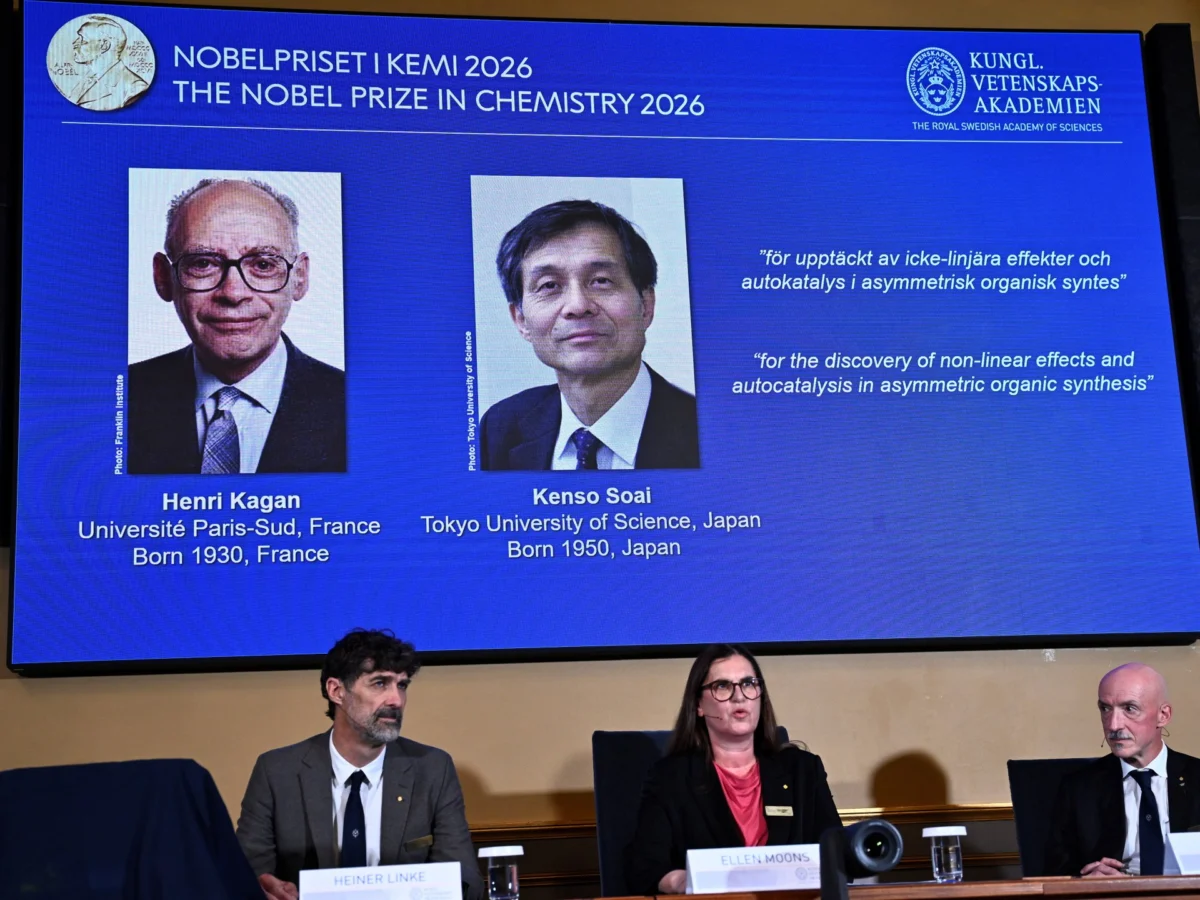
Henri Kagan and Kenso Soai have won the Chemistry Nobel for their work on mirror image chemistry that solved a long-standing mystery about asymmetric molecules. Their research helped explain how certain molecules form in only one orientation rather than both, a discovery that has aided the production of pharmaceuticals.
The Nobel Committee recognized their contributions to understanding asymmetric synthesis, which plays a key role in the development of safe and effective medicines. Mirror image chemistry deals with molecules that are identical in structure but opposite in orientation, much like human hands. These molecules, known as enantiomers, can behave very differently inside the body, making the control of their formation critical in drug design.
Key Facts:
- Henri Kagan and Kenso Soai won the Chemistry Nobel Prize.
- They were honored for a mirror image chemistry breakthrough.
- Their work helped solve a mystery about asymmetric molecules.
- Their research has aided the manufacture of pharmaceuticals.
What happens next?
The Nobel Prize in Chemistry is awarded annually by the Royal Swedish Academy of Sciences. Each year, the committee selects scientists whose work has significantly advanced the field of chemistry. The prize includes a medal, a diploma, and a cash award, and is typically presented in December during a formal ceremony in Stockholm.
The recognition of mirror image chemistry highlights its importance in modern science. Asymmetric molecules are essential in pharmacology because drug efficacy and safety often depend on the correct molecular orientation. Being able to synthesize one enantiomer over another allows scientists to create medications with fewer side effects and more precise therapeutic outcomes.
Who is affected?
While Henri Kagan and Kenso Soai are direct recipients of the honor, the broader scientific community benefits from their research. Pharmaceutical companies use the principles of mirror image chemistry to improve drug manufacturing processes. Patients also benefit indirectly, as better-controlled synthesis methods lead to safer medications. Academic institutions and researchers in organic chemistry continue to build upon their findings.
How did we get here?
The concept of molecular chirality was first noted in the 19th century, but controlling the formation of specific enantiomers remained a challenge until recent decades. Henri Kagan and Kenso Soai worked on methods to influence which version of a molecule forms during chemical reactions. Soai in particular gained recognition for his work on autocatalysis, where certain reactions produce molecules that accelerate their own production. Together, their combined efforts helped clarify how asymmetric molecules can be selectively synthesized.
What We Know — and What We Don’t
Verified by the source:
- Henri Kagan and Kenso Soai won the Chemistry Nobel Prize.
- Their work involved mirror image molecules.
- The research addressed asymmetric molecules.
- Their work contributed to the manufacture of pharmaceuticals.
Still unconfirmed:
- The specific year of the award.
- The names of the Nobel Committee members involved in the decision.
- Detailed mechanisms of their experimental methods.
- The exact number of medications currently produced using their techniques.
Why It Matters This Nobel Prize underscores the fundamental role of molecular structure in medicine. Mirror image chemistry, or the study of chiral molecules, is crucial for developing drugs that are both effective and safe. Without controlling which version of a molecule is produced, medicines can fail or even cause harm. The research of Henri Kagan and Kenso Soai has laid foundational principles still used in pharmaceutical laboratories worldwide, influencing everything from over-the-counter pain relievers to life-saving treatments for cancer and heart disease.
What To Watch Future Nobel Prizes and scientific accolades may continue to explore advancements in synthetic chemistry and molecular design. The scientific community will also watch for further developments in green chemistry, where controlling molecular symmetry can reduce waste and environmental impact in pharmaceutical manufacturing. Visit health-science and tech-ai for updates on science and innovation. Mirror image chemistry continues to evolve alongside artificial intelligence and automated synthesis tools. A meta description for this article could read: Henri Kagan and Kenso Soai won the Chemistry Nobel for mirror image research on asymmetric molecules used in pharmaceuticals.