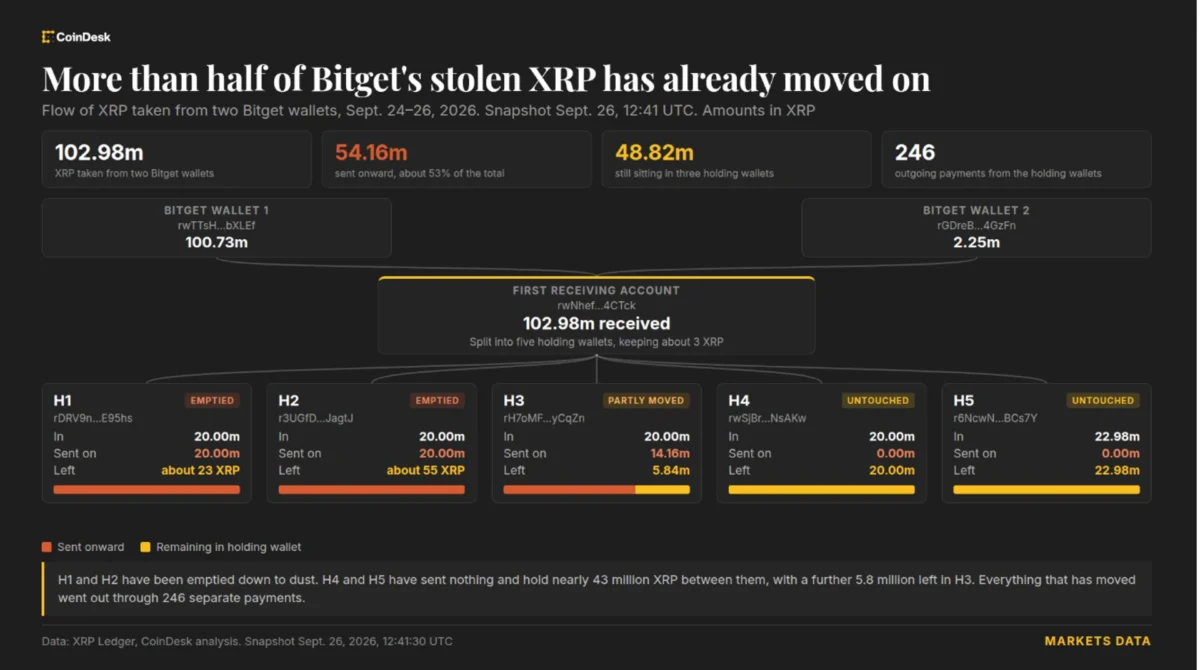
A hacker who stole funds from Bitget moved approximately $83 million worth of XRP that Ripple cannot freeze, highlighting ongoing vulnerabilities in crypto security.
Two wallets have been nearly emptied and a third is currently being drained, leaving about $75 million remaining across five original holding accounts.
This movement demonstrates the challenges exchanges face in recovering stolen digital assets once they are transferred.
Key Facts
- A hacker moved $83 million in stolen XRP.
- Ripple cannot freeze the stolen XRP.
- Two wallets were nearly emptied.
- A third wallet is being drained.
- About $75 million remains across five original holding accounts.
The Story
What happens next?
The movement of stolen XRP underscores the difficulty in tracking and recovering digital assets after a hack. Once stolen XRP leaves the original wallets, tracing becomes complex due to the decentralized nature of blockchain networks.
Ripple’s inability to freeze the tokens limits recourse for affected platforms. Exchanges and security teams may monitor blockchain activity for further transfers, but stopping the flow typically requires cooperation from other services or law enforcement.
Regulatory responses and insurance claims related to the incident remain unconfirmed. The crypto industry continues to grapple with similar incidents, prompting discussions about improved wallet security and faster intervention protocols.
Who is affected?
Bitget users and platform operators are directly impacted by the loss of funds. The theft affects customer balances and trust in exchange security measures.
Cryptocurrency investors monitoring market volatility may face indirect exposure if stolen asset liquidation affects pricing. Ripple’s XRP ecosystem also faces reputational pressure from its use in illicit transfers.
Wider crypto communities watch how exchanges respond to theft. This incident may influence future security standards and insurance coverage across trading platforms.
How did we get here?
Crypto exchange hacks have become recurring events since digital assets gained mainstream attention. Each incident reveals gaps in real-time detection and response.
This case illustrates the tension between decentralization and asset control. While blockchain transparency aids investigation, the irreversible nature of transactions complicates recovery.
Security researchers continue advising multi-signature wallets and cold storage to reduce large-scale thefts. However, implementation varies across exchanges and custodial services.
What We Know — and What We Don’
Verified by the source:
- Approximately $83 million in stolen XRP was moved.
- Ripple cannot freeze the stolen XRP.
- Two wallets were nearly emptied.
- A third wallet is being drained.
- About $75 million remains across five original holding accounts.
Still unconfirmed:
- The timeline of the theft and movement.
- The identity of the hacker or group involved.
- Whether Bitget has recovered any funds.
- Any regulatory or law enforcement response.
- The exact impact on affected users.
Why It Matters
This incident reinforces the ongoing risks facing crypto investors and exchanges. As digital assets grow in value, thefts like this highlight the urgent need for stronger security protocols and clearer recovery mechanisms.
A single-source report confirms $83 million in stolen XRP was moved and remains unfrozen across drained wallets.
What To Watch
Observers should monitor blockchain trackers for additional wallet movements and any statements from Bitget or Ripple regarding recovery efforts.
Relevant context can be found in our trading-crypto and economy-markets coverage.