Lede
Bitcoin ETF inflows
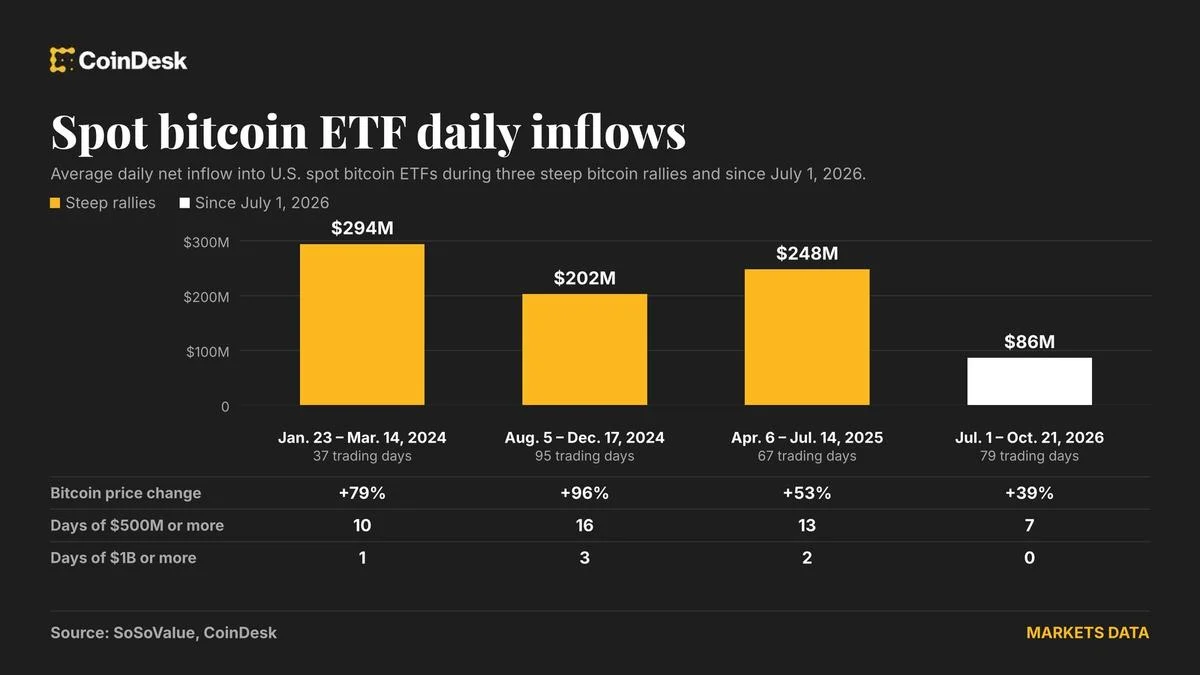
Over a three-day span, U.S. spot bitcoin exchange-traded funds accumulated approximately $1.08 billion in net inflows, according to CoinDesk data analysis. However, historical data suggests past steep price rallies were driven by roughly $235 million in daily net inflows, a benchmark the current cycle has not yet matched.
This shortfall may signal hesitancy among retail and institutional investors, despite renewed enthusiasm for crypto assets in 2025. Whether inflows can accelerate remains a key question for market participants.
While $1.08 billion in three days marks a notable uptick, it averages about $360 million per day, still falling short of earlier rally indicators.
Explore more Bitcoin ETF inflows trends here.
Key Facts
- Bitcoin ETF inflows totaled $1.08 billion over three days.
- Past rallies averaged $235 million in daily net inflows.
- CoinDesk analyzed the fund inflow data.
- Current pace has yet to match the historical rally benchmark.
The Story
What happens next?
The pace of Bitcoin ETF inflows will likely determine near-term price direction. If daily net inflows surpass the $235 million threshold seen during prior rallies, bullish sentiment could intensify. Otherwise, prices may stagnate despite the recent $1.08 billion gain.
Analysts have not specified exact thresholds, but CoinDesk noted the current average falls below historical norms. Market watchers are awaiting weekly reports from major ETF providers like BlackRock and Fidelity to assess momentum.
Who is affected?
Retail investors holding bitcoin futures or ETF shares are most directly impacted by price swings tied to inflow rates. Institutional holders, including corporate treasuries and pension funds, may also adjust exposure if momentum falters.
Broader crypto markets often mirror bitcoin’s performance, meaning altcoins like ether could see correlated volatility. Traders relying on leveraged positions face elevated risk if inflows weaken unexpectedly.
How did we get here?
The launch of spot bitcoin ETFs in early January 2024 marked a turning point, allowing traditional investors easier access to digital assets. Since then, inflows have fluctuated based on macroeconomic conditions and regulatory developments.
Analysts previously compared daily inflows during the initial months to gauge adoption speed. Slower growth in mid-2024 contrasted with late-2023 optimism, setting expectations for a sustained rally.
The October 2025 data reflects renewed interest following Federal Reserve policy shifts, though whether it matches historical strength remains uncertain.
What We Know — and What We Don’t
Verified by the source:
- Bitcoin ETF inflows reached $1.08 billion in three days.
- Past steep rallies required approximately $235 million in daily net inflows.
- Data was analyzed by CoinDesk using publicly available ETF reports.
Still unconfirmed:
- Exact identities of contributing ETF providers.
- Reason behind investor hesitation beyond historical comparisons.
- Predicted daily inflow targets needed for future rallies.
Why It Matters
Bitcoin ETF inflows
The trajectory of Bitcoin ETF inflows influences investor confidence and adoption rates, shaping the broader legitimacy of cryptocurrencies within traditional finance.
Should inflows fail to meet historical benchmarks, volatility may persist, affecting portfolio allocations across hedge funds and retail platforms alike.
Conversely, a surge beyond $235 million per day could reignite bullish forecasts, drawing fresh capital into digital asset markets worldwide.
What To Watch
Future weekly reports from leading ETF issuers will clarify whether inflows accelerate toward historical rally levels. Investors should monitor daily net totals closely as indicators of sustained momentum.
Bitcoin ETF inflows reached $1.08 billion over three days but fall short of the $235 million daily average seen in past rallies, per CoinDesk analysis.