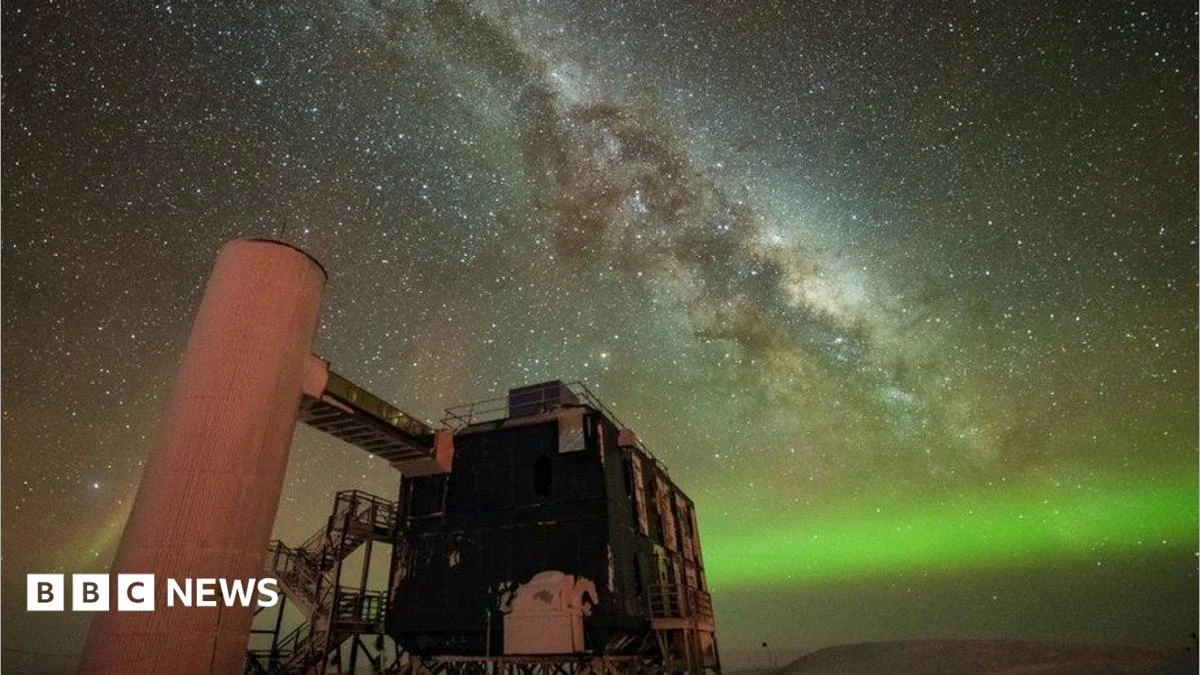
A Belgian physicist has been awarded the Nobel Prize in Physics for groundbreaking work detecting ‘ghost particles’ from space using a specialized observatory. Prof Francis Halzen’s pioneering efforts helped develop instruments capable of observing these elusive subatomic particles that rarely interact with matter as they travel across the cosmos.
The Nobel Committee recognized this achievement as a major leap forward in understanding high-energy phenomena occurring far beyond Earth’s atmosphere.
KEY FACTS
- Prof Francis Halzen, a Belgian physicist, has won the Nobel Prize in Physics.
- He was honored for his work on an observatory that detects particles from space.
- His research focused on detecting so-called ‘ghost particles’.
What Are Ghost Particles?
Ghost particles, also known as neutrinos, are subatomic particles with almost no mass that travel at nearly the speed of light. They are produced by cosmic events such as supernovae or black hole activity but pass through most matter — including human bodies and planets — without interaction. Detecting them requires massive, ultra-sensitive instruments buried deep underground to shield against other radiation. These ghost particles offer scientists a unique window into astrophysical processes otherwise hidden from view.
The observatory used by Prof Halzen reportedly captures traces of neutrino impacts within its detector array, allowing researchers to trace their origins back to distant regions of space.
How Did We Get Here?
The development of neutrino astronomy began decades ago when scientists first theorized that these neutral leptons could carry information across galaxies largely unimpeded. Over time, experimental setups evolved from small lab prototypes to large-scale installations like the IceCube Neutrino Observatory located in Antarctica. This facility uses a cubic kilometer of Antarctic ice embedded with optical sensors to catch rare collisions between neutrinos and atoms in the glacial ice, marking a milestone in particle astrophysics.
Such projects have enabled astronomers to study cosmic accelerators—extremely powerful natural sources generating energetic particles over vast distances.
What Happens Next?
With renewed global interest following the Nobel announcement, new collaborations may emerge around expanding similar facilities or upgrading existing ones. Future missions might aim to increase precision in pinpointing neutrino sources and enhance real-time alert systems for multimessenger astronomy combining light, gravitational waves, and neutrino data. Researchers continue refining detection methods to unlock more secrets hidden in the universe’s tiniest messengers.
WHAT WE KNOW — AND WHAT WE DON’T
Verified by the source:
- Prof Francis Halzen won the Nobel Prize in Physics.
- The award relates to his work involving an observatory detecting space-originating particles.
- Those particles are referred to as ‘ghost particles’.
Still unconfirmed:
- Specific details about which observatory exactly earned him the prize.
- The precise mechanism of how the detection system operates.
- Names of collaborators or institutions directly involved in the project.
- Date or location of the official Nobel ceremony or related announcements.
WHY IT MATTERS
This recognition underscores growing scientific momentum in exploring the universe through non-traditional means. As traditional telescopes reach limits peering into certain cosmic mysteries, alternative approaches using ghost particles provide fresh insights into some of nature’s most extreme environments.
WHAT TO WATCH
Official statements from the Royal Swedish Academy of Sciences are expected soon detailing full citations and future implications for international neutrino research initiatives.